 Pусский
4 Quality Control Processes for Diffused Silicon Level Transmitters
From: Issued date 2026.06.05 Back
Introduction
A level transmitter may pass initial functional checks yet still experience accuracy drift, unstable output, or reliability issues in the field if critical manufacturing controls are not properly implemented. In our production experience, most long-term performance problems can be traced back to small deviations during assembly, calibration, wiring verification, or final testing.
For a diffused silicon level transmitter, measurement performance depends not only on the sensing element itself but also on the consistency of the entire manufacturing process. Every production stage must be carefully controlled to ensure accuracy, repeatability, and long-term stability.
OEM buyers, ODM customers, procurement managers, and quality engineers often ask the same questions:
How are diffused silicon level transmitters manufactured?
How is calibration performed?
How is measurement accuracy verified?
How is batch-to-batch consistency maintained?
What testing methods are used before shipment?
This article explains the four key production and quality-control processes behind high-performance diffused silicon level transmitters and demonstrates how we ensure reliable product performance through structured manufacturing, calibration, inspection, and testing procedures.
Why Manufacturing Quality Matters
A level transmitter is expected to provide stable and accurate measurements throughout its service life. Whether installed in water treatment systems, industrial tanks, chemical storage vessels, or process-control applications, performance consistency is critical.
The quality of a level transmitter is directly influenced by:
Sensor assembly accuracy
Electronic circuit integrity
Calibration precision
Cable configuration correctness
Production process consistency
Final testing effectiveness
Even minor manufacturing deviations can affect:
Output linearity
Zero-point stability
Measurement repeatability
Long-term reliability
Environmental durability
This is why Level Transmitter Quality Control must be integrated throughout the entire manufacturing workflow rather than relying solely on final inspection.
Overview of the Manufacturing Process
The production process of a diffused silicon level transmitter consists of four primary stages:
Front-End Assembly
Calibration and Adjustment
Back-End Assembly
Finished Product Testing
Each stage contains dedicated quality checkpoints designed to identify and eliminate potential defects before the product proceeds to the next manufacturing phase.
The overall workflow follows this sequence:
Sensor Component Assembly → Calibration and Data Acquisition → Final Product Assembly → AUT200 Verification → Shipment Approval
By implementing inspection and verification throughout the process, we minimize variation and ensure consistent product performance across production batches.
Step 1: Front-End Assembly
The first stage of the manufacturing process is front-end assembly.
At this stage, operators complete the assembly of the sensor head components, including:
Sensor
Buffer plate
Fixture
Pressure ring
Amplifier board
This process establishes both the mechanical structure and the signal transmission path of the transmitter.
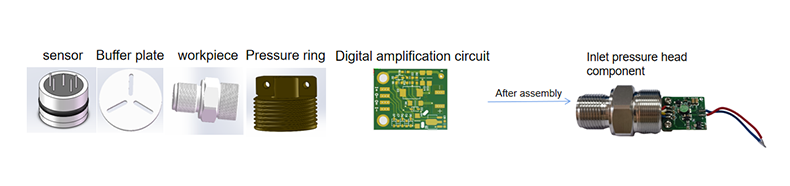
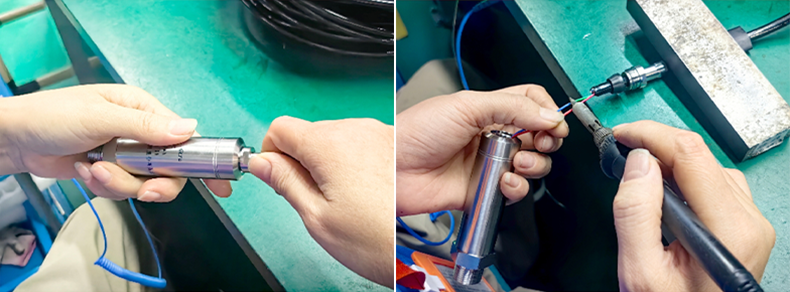
Critical Quality Checkpoint: Amplifier Board Soldering Verification
During front-end assembly, operators must carefully verify the soldering quality of the amplifier board.
Poor solder joints can result in:
Signal instability
Output fluctuations
Increased electrical noise
Long-term reliability failures
Our production team performs visual inspection and workmanship verification before the assembly proceeds to calibration.
Why This Process Is Important
The sensing element generates the raw signal, while the amplifier board conditions and transmits that signal to the output circuitry.
Any assembly defect introduced during this stage may affect:
Measurement accuracy
Output stability
Product lifespan
Environmental reliability
For this reason, front-end assembly represents one of the most important quality checkpoints in the diffused silicon level sensor production process.
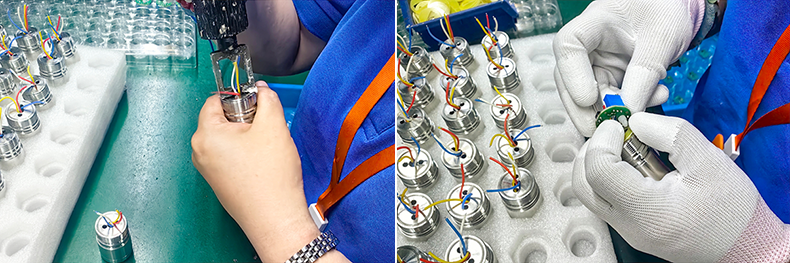
Step 2: Calibration and Adjustment
Once assembly is completed, the product enters the calibration stage.
This process determines whether the transmitter can meet specified performance requirements.
Calibration Method
We perform calibration using either:
Analog circuits
Digital circuits
The selected calibration method depends on product design requirements and performance specifications.
The purpose of calibration is to produce transmitters that satisfy all required performance parameters.
Pressure Stabilization Before Data Collection
One critical requirement during calibration is pressure stabilization.
Before data collection begins, pressure must remain stable for 5 seconds.
Only after the pressure has stabilized for the required duration do we perform data acquisition.
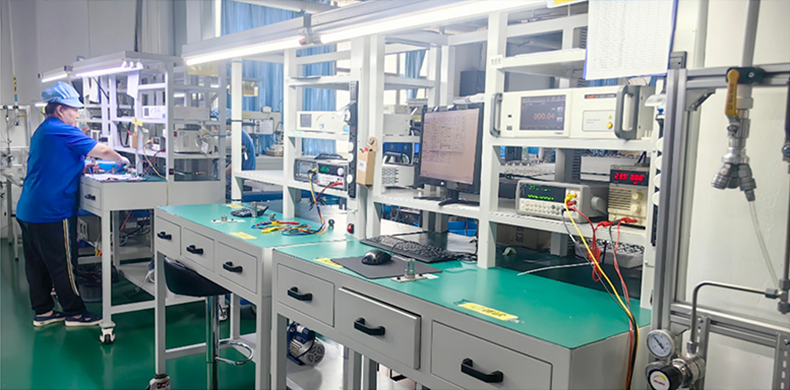
Why the 5-Second Stabilization Requirement Matters
Pressure systems frequently experience transient fluctuations immediately after pressure application.
If calibration data is collected too early, potential issues include:
Zero offset errors
Span deviation
Reduced repeatability
Increased measurement uncertainty
Waiting for pressure stabilization ensures that calibration data accurately reflects actual sensor performance.
Calibration Objectives
During this process, we verify:
Zero-point performance
Span performance
Output stability
Linearity characteristics
Accuracy requirements
This stage is a critical component of the industrial level transducer calibration process and directly affects final measurement performance.
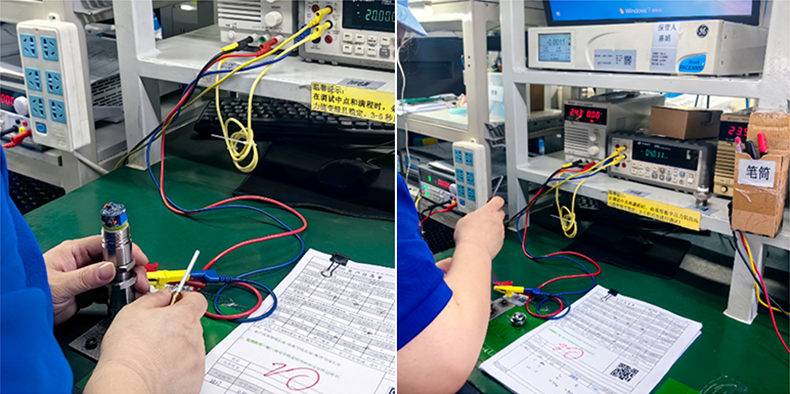
Step 3: Back-End Assembly
After calibration is completed, the transmitter enters the back-end assembly stage.
This process involves the completion of final product assembly and configuration.
Main Assembly Activities
The production team performs:
Final component assembly
Structural integration
Product completion according to specifications
At this stage, the transmitter begins to take its final form.
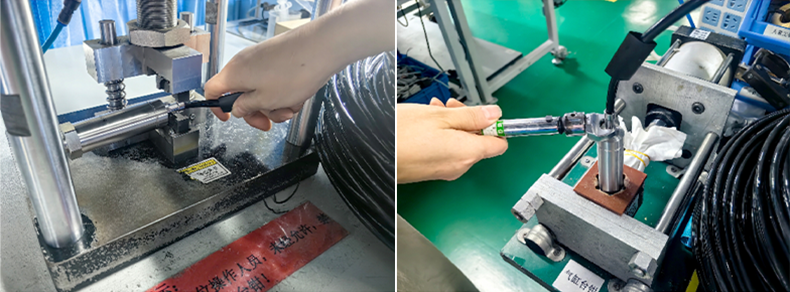
Critical Quality Checkpoint: Cable Length Verification
One specific inspection requirement is cable-length verification.
Operators verify cable length according to the product parameter sheet.
This process ensures that the final configuration exactly matches customer requirements.
Why Cable Verification Is Necessary
Incorrect cable lengths may cause:
Installation difficulties
Customer complaints
Product nonconformities
Additional field modifications
By comparing cable lengths against documented specifications, we prevent configuration-related errors before final testing.
This verification step is especially important in OEM level transmitter manufacturing processes, where customized cable lengths are frequently required.
Step 4: Finished Product Testing
Finished product testing is the final manufacturing verification stage before shipment approval.
AUT200 System Verification
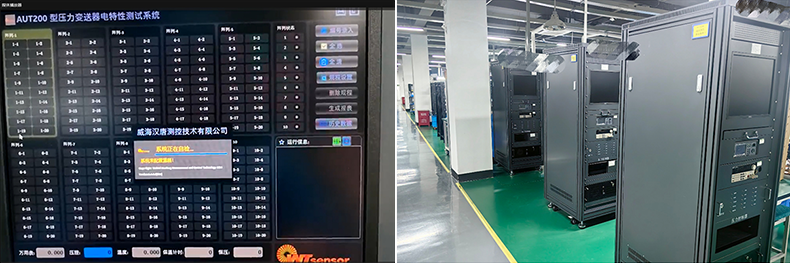
We use the AUT200 System to perform finished product testing.
The AUT200 System is used before shipment to verify whether each transmitter meets required performance indicators.
100% Finished Product Indicator Testing
Every transmitter undergoes:
100% finished product indicator testing
This means every manufactured unit is tested individually.
No products bypass this verification stage.
Testing Objectives
The AUT200 System helps identify:
Calibration deviations
Electrical abnormalities
Output inconsistencies
Assembly-related defects
Testing every unit provides an additional layer of protection against shipment of nonconforming products.
Why 100% Testing Matters
Sampling inspections may miss isolated failures.
A complete testing strategy allows us to verify performance across the entire production batch and significantly reduce quality risks.
This process forms a critical part of our transmitter production testing and quality assurance system.
Quality-Control System
Manufacturing consistency depends on more than assembly and calibration procedures. It also requires a structured quality-management system.
Incoming Material Inspection
Before production begins, incoming materials undergo verification.
Inspection activities include:
Material confirmation
Component verification
Appearance inspection
Documentation review
This prevents nonconforming materials from entering production.
First Article Inspection (FAI)
Before mass production starts, First Article Inspection (FAI) verifies:
Assembly accuracy
Process compliance
Product configuration correctness
Potential issues can be identified before larger quantities are produced.
Self-Inspection
Operators perform self-inspections throughout production.
These inspections focus on:
Assembly quality
Workmanship
Process adherence
Self-inspection provides immediate feedback at the workstation level.
Process Inspection
Quality personnel perform process inspections at key manufacturing stages.
Inspection focuses on:
Assembly consistency
Calibration compliance
Process execution
This helps identify deviations before they affect larger production quantities.
Patrol Inspection
Patrol inspections are conducted periodically throughout production.
Inspectors review:
Production conditions
Operator compliance
Process implementation
Work instructions
Regular patrol inspections help maintain process discipline and manufacturing consistency.
Final Inspection
Final inspection verifies:
Product conformity
Calibration completion
Testing completion
Documentation accuracy
Only approved products are released for shipment.

Calibration and Testing Procedures
Calibration and testing represent the foundation of how to ensure accuracy of level transmitters.
Our standard workflow includes:
Front-end assembly
Calibration preparation
Pressure application
Pressure stabilization for 5 seconds
Data acquisition
Analog or digital adjustment
Performance verification
Back-end assembly
AUT200 System testing
100% finished product testing
This process ensures that calibration is verified by an independent final testing stage.
Rather than relying solely on calibration results, we confirm performance through multiple verification points before shipment approval.
Pressure Sensor Manufacturing Guide
Common Production Risks and Preventive Measures
During liquid level sensor manufacturing, several risks must be carefully controlled.
Sensor Drift
Risk:
Sensor output changes over time.
Preventive Measures:
Controlled calibration procedures
Stable pressure verification
Final performance testing
Calibration Deviation
Risk:
Incorrect calibration parameters reduce accuracy.
Preventive Measures:
Analog or digital adjustment
Pressure stabilization before data acquisition
Final verification testing
Soldering Defects
Risk:
Poor amplifier board soldering affects signal integrity.
Preventive Measures:
Operator verification
Visual inspection
Workmanship control
Assembly Errors
Risk:
Incorrect component installation.
Preventive Measures:
FAI
Self-inspection
Process inspection
Cable Configuration Errors
Risk:
Incorrect cable length or configuration.
Preventive Measures:
Verification against parameter sheets
Back-end assembly inspection
Batch Variation
Risk:
Performance differences between production batches.
Preventive Measures:
Standardized procedures
Consistent calibration methods
AUT200 verification
100% testing
Traceability and Production Records
Traceability plays an essential role in OEM and ODM manufacturing.
For each production batch, records are maintained to support quality investigations and continuous improvement activities.
Typical records include:
Production batch information
Assembly documentation
Calibration records
Inspection reports
Testing results
Final verification records
Traceability enables rapid root-cause analysis if field issues occur and provides confidence for customers requiring documented manufacturing controls.
What OEM and ODM Customers Care About
When evaluating a level transmitter supplier, OEM and ODM customers often focus on manufacturing capability rather than product specifications alone.
Key concerns include:
Product Consistency
Stable manufacturing processes reduce variation between units and batches.
Qualification Rates
Effective process controls improve production yield and reduce rework.
Warranty Risk
Detecting defects before shipment reduces field failures.
Maintenance Costs
Accurate calibration minimizes service requirements.
Long-Term Reliability
Controlled assembly and testing improve product durability.
Supply Stability
Documented production procedures support scalable and repeatable manufacturing.
For industrial customers, these factors often have a greater impact on total ownership cost than initial purchase price.
Continuous Improvement and Manufacturing Optimization
Quality improvement is an ongoing process.
Our engineering and production teams continuously review:
Yield performance
Calibration data
Inspection findings
Testing results
Customer feedback
When abnormalities are identified, root-cause analysis is conducted to determine the source of the issue.
Corrective actions may include:
Process optimization
Work instruction updates
Inspection enhancements
Training improvements
Preventive actions are then implemented to reduce the likelihood of recurrence.
This continuous-improvement approach helps maintain stable quality levels while supporting future manufacturing efficiency improvements.
Piezoresistive Sensor Technology Center
FAQ
How is a diffused silicon level transmitter calibrated?
Calibration is performed using analog circuits or digital circuits. Pressure must remain stable for 5 seconds before data acquisition begins.
Why is pressure stabilization required during calibration?
Pressure stabilization prevents transient pressure fluctuations from affecting calibration accuracy and repeatability.
What components are assembled during front-end assembly?
Front-end assembly includes the sensor, buffer plate, fixture, pressure ring, and amplifier board.
Why is amplifier board soldering inspected?
Soldering quality directly affects signal transmission, output stability, and long-term reliability.
How is cable length controlled during manufacturing?
Operators verify cable length according to the product parameter sheet during back-end assembly.
What is the purpose of the AUT200 System?
The AUT200 System is used to perform finished product verification before shipment.
Is every transmitter tested before shipment?
Yes. Every unit undergoes 100% finished product indicator testing.
How is batch consistency maintained?
Batch consistency is maintained through standardized assembly procedures, calibration controls, inspections, and final testing.
What production records should be maintained for traceability?
Production records typically include assembly documentation, calibration records, inspection reports, testing data, and batch information.
Why do OEM customers evaluate manufacturing processes?
Manufacturing processes directly affect product consistency, qualification rates, reliability, warranty risk, and long-term supply stability.