 Pусский
What is a Metal Bellows? Complete Guide for Engineers
From: Issued date 2026.09.10 Back
What is a Metal Bellows? Complete Guide for Engineers
If you design pressure transmitters, vacuum systems, cryogenic equipment, or mechanical seals, you have probably specified a metal bellows — the thin-walled, corrugated metal tube that flexes millions of times while staying pressure-tight.
WTsensor (Nanjing Wotian Technology) has manufactured electroformed (electrodeposited) metal bellows since 2005, and this guide reflects what we have learned about bellows design, manufacturing, and failure across two decades of service in sensors, vacuum, and cryogenic applications.
This guide covers what a metal bellows is, how the electroformed type is made, how the three manufacturing families compare, which parameters matter, how bellows fail, and how to evaluate a supplier.
What is a metal bellows?
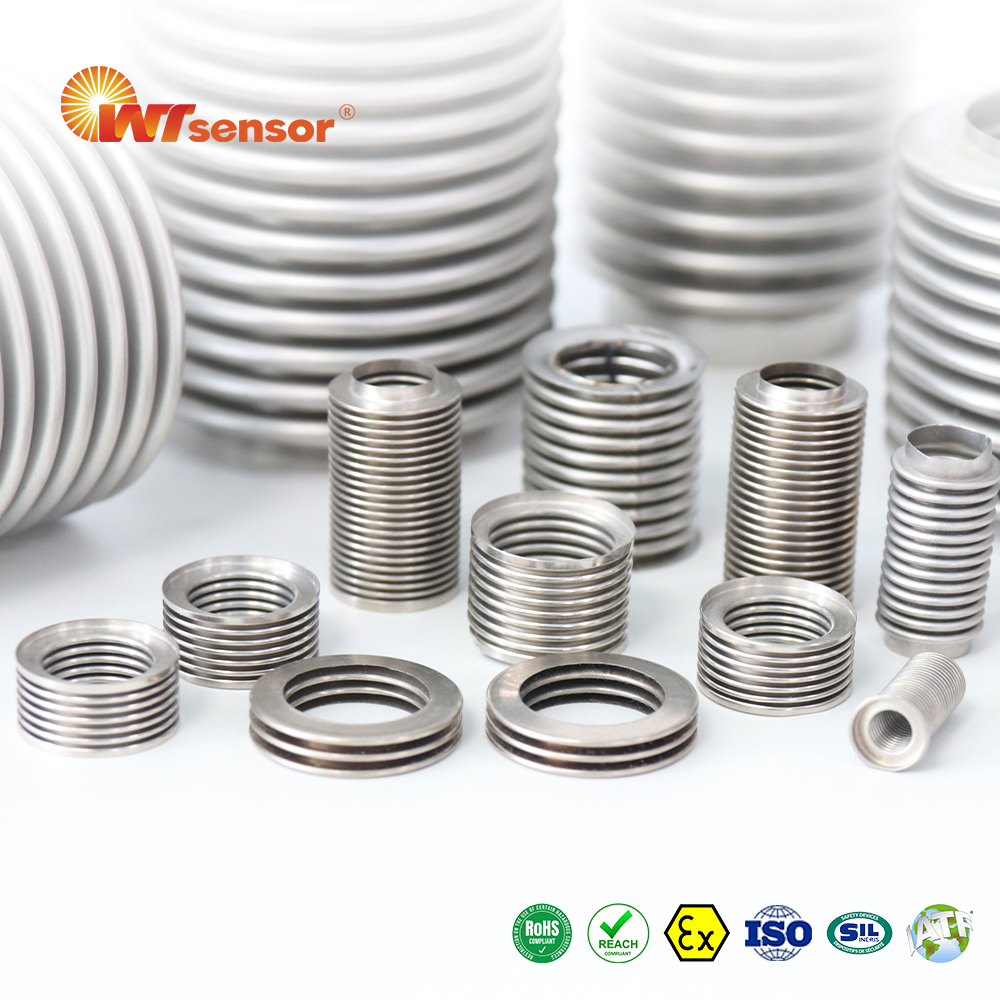
A metal bellows is a thin-walled, corrugated cylindrical component that expands and contracts axially while remaining pressure-tight. It converts pressure, force, or displacement into measurable motion — or isolates one medium from another while transmitting motion.
Bellows appear in four common engineering roles:
Elastic sensing elements — the core of pressure gauges, pressure switches, and mechanical sensors, converting pressure into deflection.
Volume compensators and isolators — separating process media from instrumentation in pressure transmitters and sealing systems.
Vacuum and cryogenic feedthroughs — flexible, leak-tight connections for LNG, liquid nitrogen, and superconducting systems.
Sealing elements — flexible barriers in mechanical seals and valve stem seals that tolerate shaft movement.
How does a metal bellows work?
A bellows behaves as a precision spring. When pressure acts on its effective area, or when an axial force is applied, the convolutions deform elastically and the bellows shortens or extends. When the load is removed, it returns to its original length — for hundreds of thousands of cycles, if designed and manufactured correctly.
Three parameters define its mechanical behavior:
Spring rate (K) — the force required per unit of deflection, expressed in N/mm.
Sensitivity (S) — the inverse of spring rate (S = 1/K): how much deflection you get for a given load.
Effective area (Ae) — the equivalent area that converts pressure into force, calculated as Ae = (π × Dm²)/4 using the mean diameter.
A soft bellows (low K) gives large deflection for small pressure changes — ideal for sensing. A stiff bellows resists compression — ideal for sealing and isolation. Choosing the right stiffness profile is the first decision in any bellows design.
Types of metal bellows
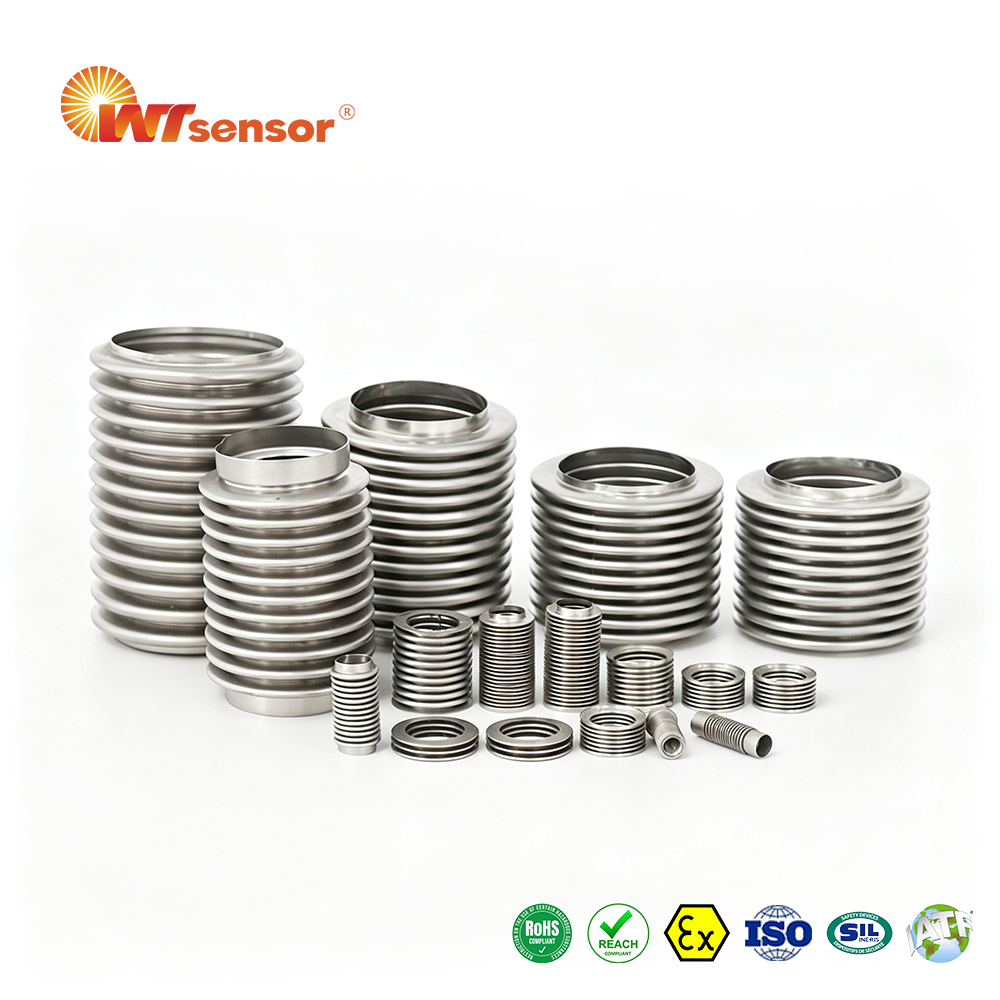
In general engineering terms, metal bellows fall into three manufacturing families:
Formed (hydroformed) bellows — thin metal tubes are hydraulically or mechanically formed into convolutions. Economical at larger diameters, but wall thickness varies through the convolution.
Welded (diaphragm) bellows — stamped annular diaphragms are welded alternately at their inner and outer edges. Capable of long strokes, but each weld is a potential leak point and a cost driver.
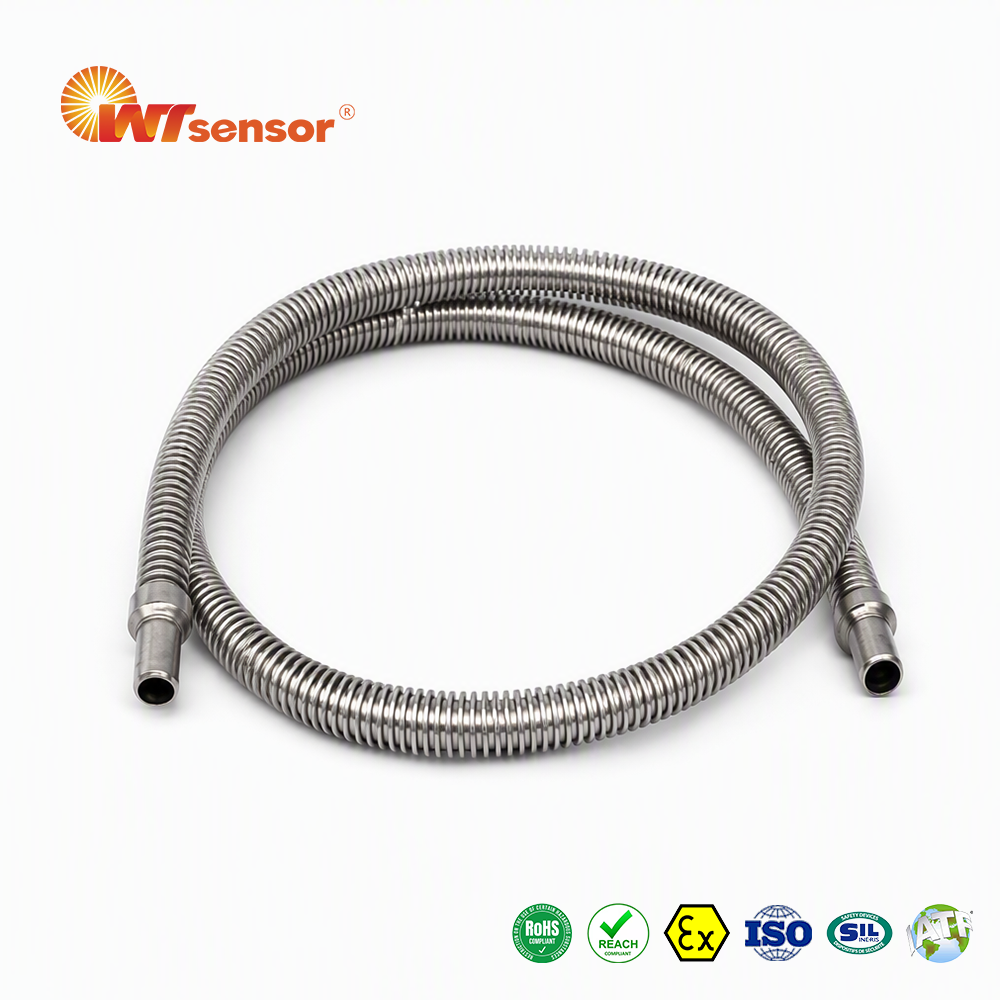
Electroformed (electrodeposited) bellows — metal is deposited atom-by-atom onto a shaped mandrel, producing a seamless, one-piece part with uniform wall thickness and no welds.
The choice between them depends on your stroke, pressure, temperature, and precision requirements — the comparison below helps you shortlist.
Metal Bellows Comparison: Electroformed vs. Welded vs. Formed
| Feature | Electroformed | Welded | Formed |
|---|---|---|---|
| Welds | None | Multiple | None |
| Wall thickness | Highly uniform | Depends on diaphragm | Variable |
| Hermeticity | Excellent | Weld-dependent | Good |
| Fatigue life | Excellent | Good | Application-dependent |
| Miniaturization | Excellent | Good | Limited |
| Typical use | Sensors, vacuum, cryogenic | High-stroke applications | Larger components |
How to read this table: electroformed bellows are the strongest choice for precision sensing, vacuum, and cryogenic duty where hermeticity and fatigue life dominate. Welded bellows earn their place in applications requiring very long stroke at moderate precision. Formed bellows are the economical option for larger, less demanding components. Confirm the ratings against your own pressure, stroke, and temperature envelope with the manufacturer before specifying.
How are electroformed metal bellows manufactured?
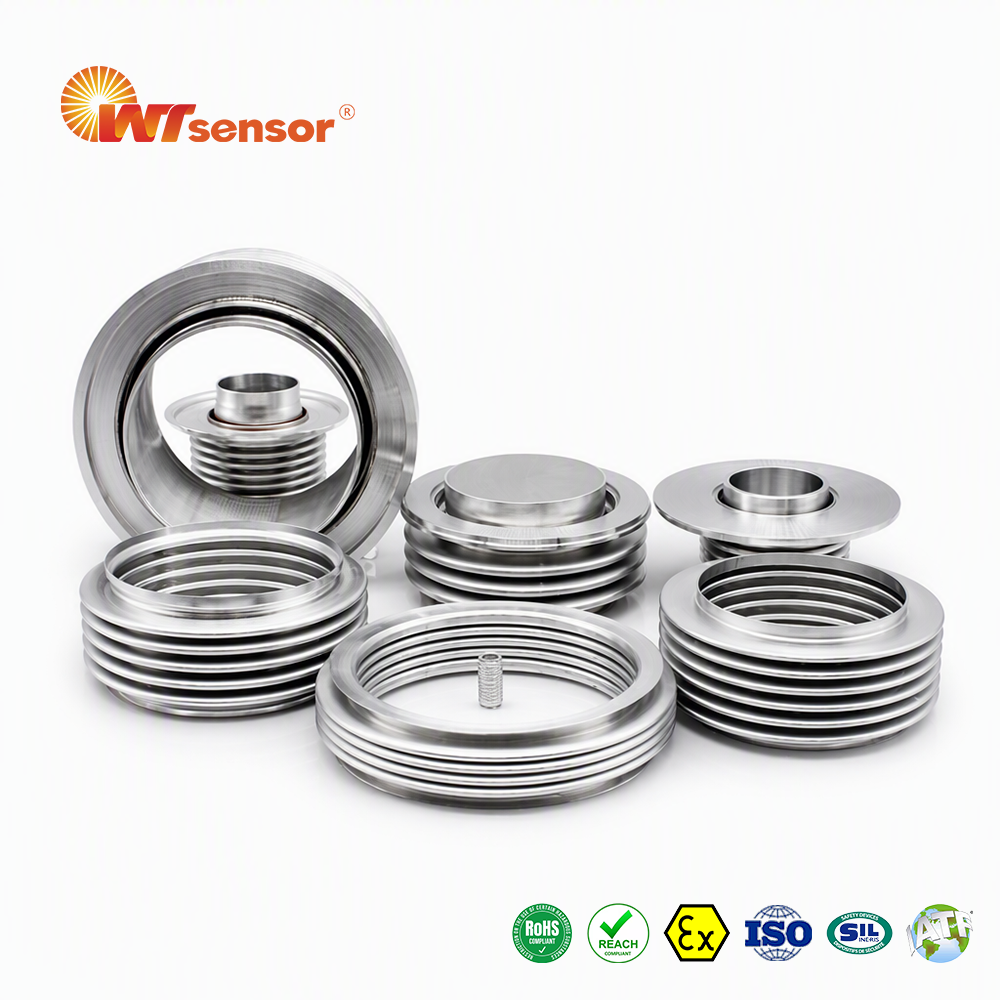
Electroforming is fundamentally different from machining or welding — the bellows is grown, not cut or joined. The process follows six stages:
1. Mandrel preparation. A precision mandrel is machined to the exact internal profile of the required bellows — its convolutions become the negative of the finished part.
2. Surface treatment. The mandrel is cleaned and treated so the deposited metal will release cleanly at the end of the process, but not before.
3. Electrodeposition. The mandrel is immersed in an electroplating bath, and nickel-cobalt alloy is deposited onto its surface. Because deposition follows the mandrel contour exactly, wall thickness stays uniform across every convolution — the property that drives electroformed bellows' fatigue life.
4. Mandrel removal. The mandrel is dissolved or released chemically, leaving a seamless, one-piece bellows with no welds, no joints, and no weak points.
5. Final forming and trimming. The bellows is trimmed to length; flanges or end fittings are attached if required.
6. Verification. Every part is checked for geometry and spring rate, then helium leak tested with a mass spectrometer.
At WTsensor, electroformed metal bellows are produced through in-house mandrel preparation, electroforming, mandrel removal, trimming, and helium leak testing — the same process we have run for sensor, vacuum, and cryogenic customers since 2005.
Key performance parameters to check
When specifying or buying a metal bellows, six parameters decide whether it survives your application:
| Parameter | Benchmark | Why it matters |
|---|---|---|
| Material purity | Ni + Co ≥ 99.8% (electroformed) | Higher purity means fewer inclusions and better fatigue resistance |
| Hermeticity (leak rate) | < 1.0×10⁻⁹ Pa·m³/s (helium-tested) | True hermeticity — no leak path through wall or welds |
| Service life | > 100,000 cycles | The bellows must outlive the equipment it protects |
| Temperature range | −196 °C to +176 °C | Liquid-nitrogen compatibility opens cryogenic applications |
| Spring rate (K) | Specified per design (N/mm) | Determines deflection per unit pressure or force |
| Effective area (Ae) | Calculated from mean diameter | Converts pressure to force — the sensing equation |
Important: rated values — service life, temperature range, and leak rate — apply to a correctly designed bellows operating within its specified pressure, stroke, temperature, and installation conditions. Confirm the ratings for your specific configuration and duty cycle with the manufacturer; a bellows run beyond its rated stroke or pressure will not achieve its rated life.
Common metal bellows failure causes
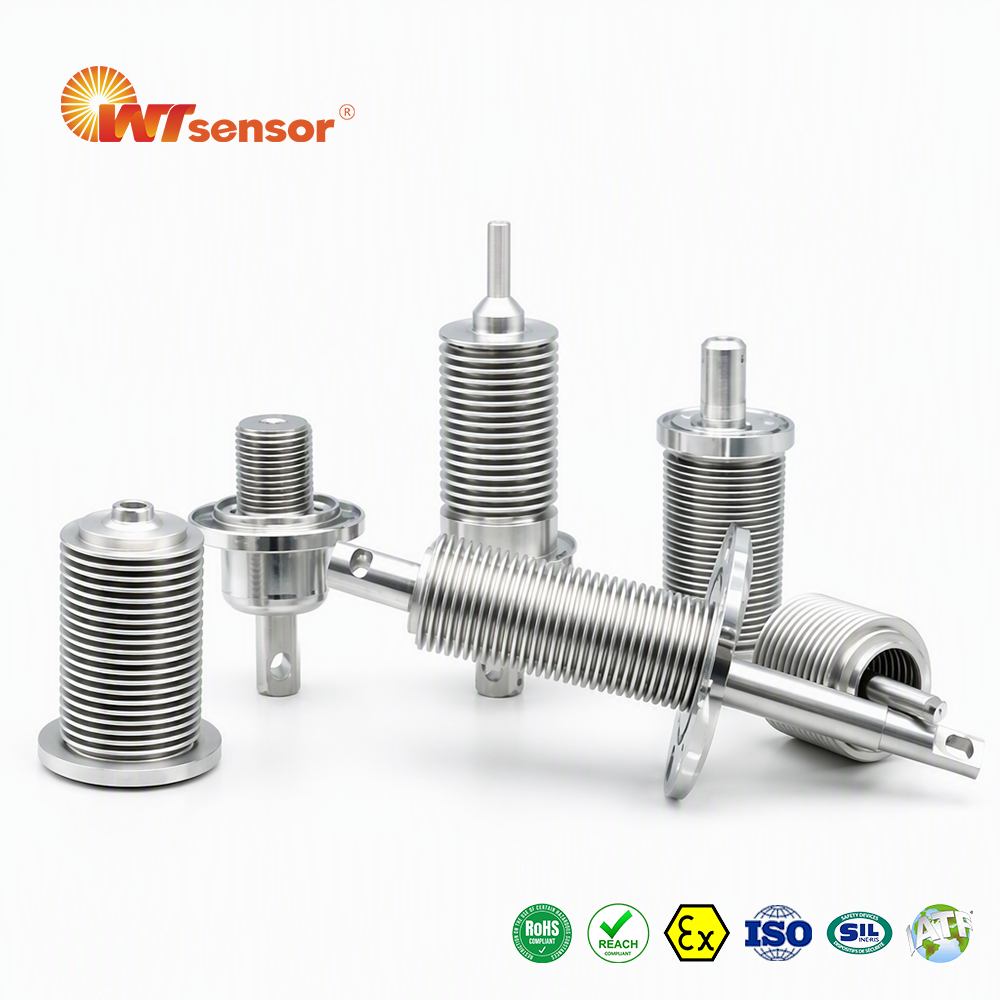
A bellows usually fails for one of four reasons. Knowing them helps you specify correctly — and question suppliers effectively.
1. Fatigue cracking. Every cycle bends the convolution walls. If the design stroke exceeds the elastic limit, or wall thickness varies, micro-cracks appear at the convolution roots and grow until the bellows leaks. Prevention: confirm the rated stroke against your actual application cycle, and require uniform wall thickness — a defining advantage of the electroformed process.
2. Corrosion. Process media or condensation attacks the bellows material over time. Prevention: match the alloy to the media; high-purity nickel-cobalt offers good resistance in most industrial and cryogenic environments.
3. Overpressure or overstroke. Exceeding the rated pressure or compression collapses the convolutions permanently. Prevention: verify both the pressure rating and the mechanical stop limits of your assembly.
4. Inadequate leak testing. A bellows with a pinhole or material defect may pass a sampling inspection and fail in the field. Prevention: require helium leak testing on production parts, with a documented acceptance limit below 1.0×10⁻⁹ Pa·m³/s.
Applications of metal bellows
Because a bellows is simultaneously a spring, a seal, and a volume compensator, it appears wherever precision and leak-tightness meet:
Pressure sensors and transmitters — isolating the sensing element from process media while transmitting pressure.
Pressure gauges and switches — the elastic element that converts pressure into pointer or contact movement.
Vacuum systems — flexible, hermetic connections for chambers and feedthroughs.
Cryogenic equipment — LNG, liquid nitrogen, and superconducting systems down to −196 °C.
Aerospace and defense — volume compensators and seals that must survive extreme temperature swings.
Semiconductor equipment — precision bellows in vacuum load locks and process chambers.
How to choose an electroformed metal bellows manufacturer
Five questions separate a manufacturing partner from a reseller:
Can they prove hermeticity? Ask for helium leak test data. Below 1.0×10⁻⁹ Pa·m³/s is the benchmark.
Do they control the material? Electroforming from high-purity nickel-cobalt (Ni + Co ≥ 99.8%) is a different quality level from generic formed bellows.
Can they document life under your conditions? Fatigue testing to >100,000 cycles means little unless it matches your pressure, stroke, and temperature duty. Ask for the test conditions behind the number.
Do they handle cryogenic service? Confirm the operating range covers your temperature — down to −196 °C if your application touches liquid nitrogen.
Can they manufacture to drawings? A custom metal bellows manufacturer should review your drawing, confirm spring rate and effective area against your requirements, and return a technical evaluation.
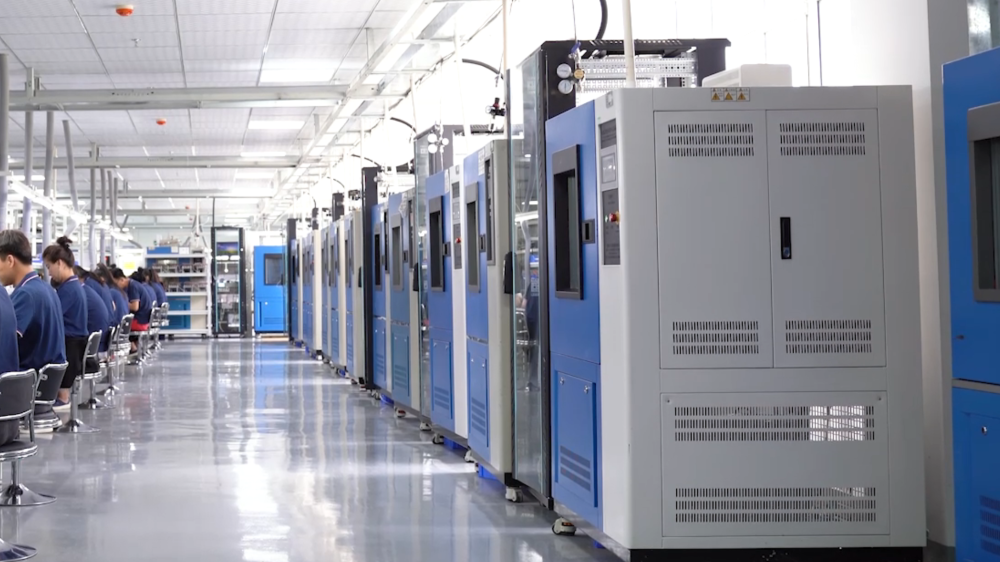
WTsensor is an electroformed metal bellows manufacturer with over 20 years of sensor and seal production experience, operating in a 25,000 m² base alongside its pressure sensor,glass-to-metal seal component line, with in-house electroforming, helium leak testing, and an 18-month warranty on every part.

FAQ
What is a metal bellows used for? Metal bellows are used as elastic sensing elements (pressure gauges, switches, sensors), as flexible hermetic connections in vacuum and cryogenic systems, and as volume compensators and seals in industrial equipment.
What is the difference between welded and electroformed bellows? Welded bellows are assembled from stamped diaphragms joined by welds; electroformed bellows are grown in one piece by electrodeposition with no welds. Each has strengths: welded designs suit long-stroke service, while electroformed designs offer weld-free hermeticity and uniform wall thickness — the right choice depends on your stroke, pressure, and leak requirements.
What temperature can a metal bellows withstand? Electroformed bellows are rated from −196 °C to +176 °C for correctly designed configurations — covering liquid nitrogen, LNG, and most industrial environments. Confirm the rating for your specific design with the manufacturer.
How long does a metal bellows last? Under specified pressure, stroke, temperature, and installation conditions, a correctly designed electroformed bellows exceeds 100,000 cycles — in many installations it outlives the equipment it serves.
Can a metal bellows leak? Only if it is defective, damaged, or run beyond its rated conditions. A properly manufactured bellows is helium-tested below 1.0×10⁻⁹ Pa·m³/s and is hermetic across its design life.
Are metal bellows suitable for vacuum applications? Yes. Electroformed bellows with helium-tested hermeticity are standard components in vacuum chambers, load locks, and cryogenic feedthroughs.
Can you manufacture custom metal bellows according to drawings? Yes. We manufacture custom electroformed metal bellows from customer drawings, including specific diameters, stroke, spring rate, and end fittings. Send us your drawing and our engineers will confirm manufacturability before quoting.
What information is required for a metal bellows quotation? To quote accurately, we need: a drawing or key dimensions (diameter, length, convolution count), required stroke or spring rate, pressure and temperature range, media compatibility, target life, and estimated annual quantity.
What is the minimum order quantity for custom metal bellows? MOQ depends on the configuration — diameter, length, and end fittings — and is confirmed during quotation. Contact us with your drawing and we will include the MOQ in your quote.
Do you provide OEM bellows solutions? Yes. As an electroformed metal bellows manufacturer with in-house electroforming and helium leak testing, we support OEM projects from drawing review to volume delivery.
Need a quote or engineering review? Send us your drawing or specification — WTsensor responds with a technical evaluation and pricing within one business day.
- Read More >
-
Inside Differential Pressure Sensor Core Manufacturing: From Gold Wire Bonding to Final Protection
Read More > -
How Threaded Pressure Sensor Cores Prevent Leakage Through Controlled Manufacturing
Read More > -
How Welded Pressure Transmitters Prevent Leakage Before Calibration
Read More > -
What is a Glass-to-Metal Seal? Complete Guide for Engineers
Read More >
This article Tags: bellows electroformed bellows
Back to List