 Pусский
What is a Wireless Pressure Sensor? Complete Guide for Industrial IoT
From: Issued date 2026.09.17 Back
If you manage water networks, tank farms, pipelines, or remote process equipment, you know the real cost of pressure monitoring is rarely the sensor — it is the cable. Running power and signal wiring to a valve station or an elevated tank can cost more than the instrument itself, and in remote or hazardous locations it may not be practical at all.
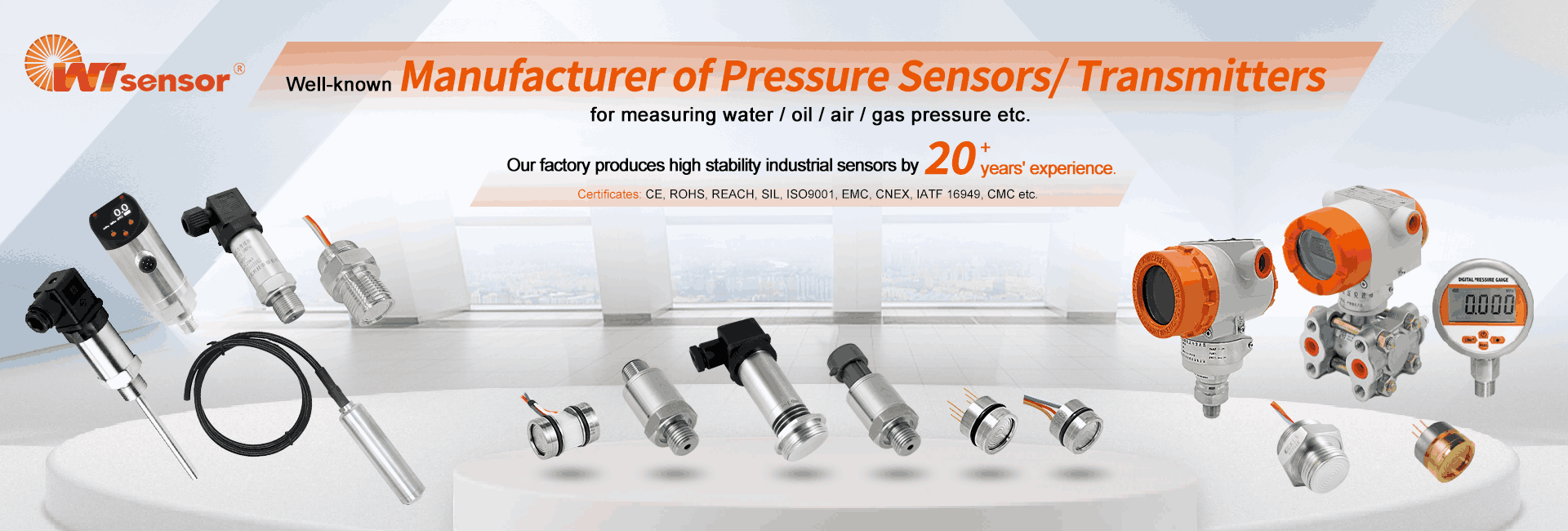
WTsensor (Nanjing Wotian Technology) has manufactured pressure sensors and transmitters since 2005, and its wireless line — including wireless pressure transmitters in 4G, NB-IoT, and LoRaWAN variants — reflects a simple observation from two decades of field service: most pressure data does not need to be read continuously, but it does need to be collected reliably.
This guide explains what a wireless pressure sensor is, how it works, how the main radio technologies compare, how battery life is actually engineered, which parameters matter when specifying one, and how to choose a manufacturer.
What is a wireless pressure sensor?
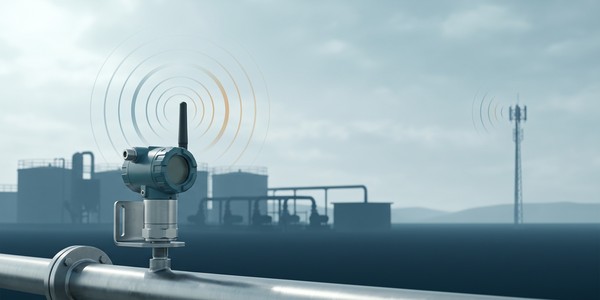
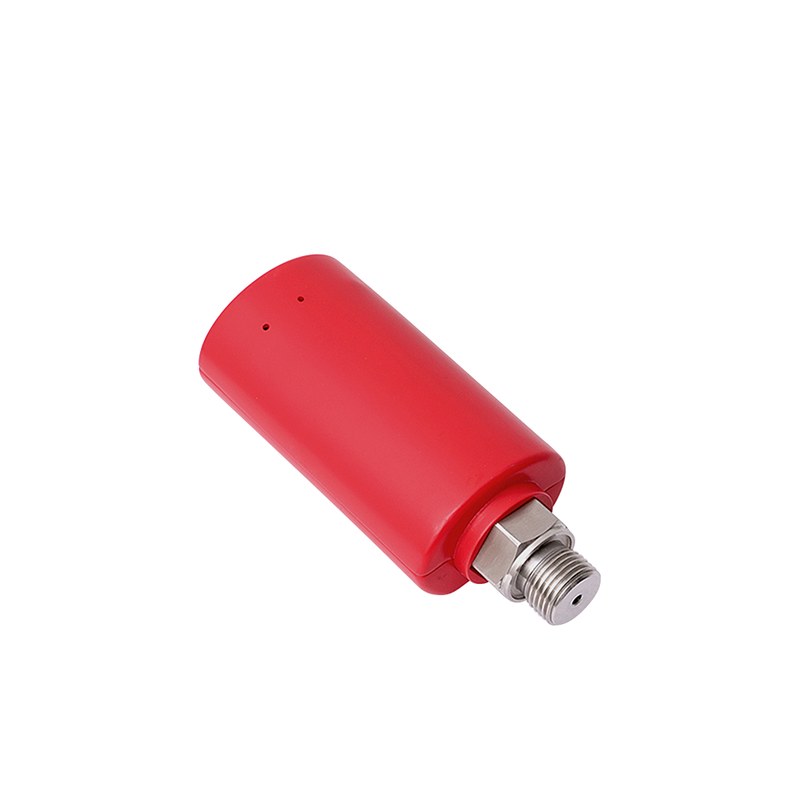
In industrial applications, the term "wireless pressure sensor" is often used as a broad search term. The actual instrument you specify is typically a battery-powered wireless pressure transmitter — a complete measurement device that combines pressure sensing, signal conditioning, computation, and wireless communication in one enclosure.
Whatever you call it, the instrument itself contains four building blocks:
A pressure sensing element, usually a diffused-silicon sensor core or strain-gauge sensor core, that converts pressure into an electrical signal.
Signal conditioning electronics, which amplify, linearize, and temperature-compensate the raw signal.
A microcontroller, which samples the pressure, applies the calibration curve, and decides when to transmit.
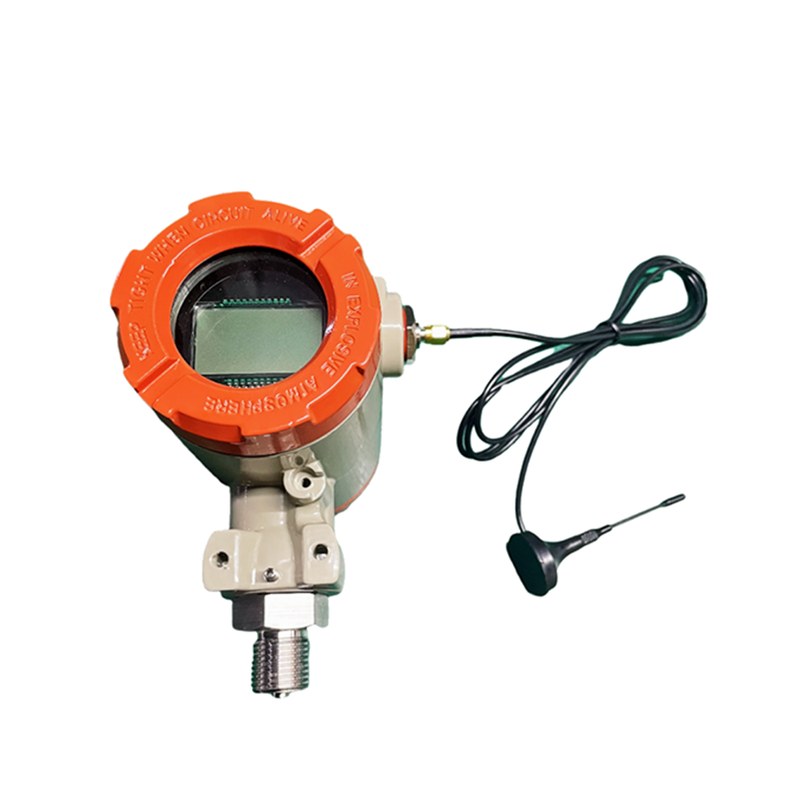
A radio module and antenna, which send the reading over a cellular network (4G, NB-IoT, LTE-M) or a private low-power network (LoRaWAN, Wi-Fi, or similar).
Unlike a wired 4–20 mA transmitter, which powers the loop and sends a continuous analog signal, a wireless transmitter carries its own battery and transmits discrete data packets on a schedule — once a minute, once an hour, or once a day, depending on the application. That schedule is the heart of the design: it is what makes years of battery life possible.
Wireless Pressure Sensor vs. Wireless Pressure Transmitter
The terms are often used interchangeably in search, but engineers and procurement teams mean slightly different things. It is worth being precise, because a request for a "sensor" and a request for a "transmitter" can land on different products in a catalog:
| Term | Typical meaning |
|---|---|
| Wireless pressure sensor | Broad/search term; may refer to the sensing element alone or to the complete device |
| Wireless pressure transmitter | Complete instrument: pressure sensing element + signal conditioning + microcontroller + wireless communication in one package |
| Wireless pressure monitoring system | The full data chain: transmitter + wireless network/gateway + server, cloud platform, or SCADA |
This guide follows the same convention: "wireless pressure sensor" is used as the broad search term that matches how buyers search, while "wireless pressure transmitter" refers to the actual instrument you install, and "wireless pressure monitoring system" to the complete data chain from field device to dashboard. When you write a specification or RFQ, naming the instrument type — transmitter or wireless pressure monitoring system — removes ambiguity about whether you need a component or an end-to-end solution.
How does a wireless pressure sensor work?
The operating cycle is deliberately simple:
1. Sleep. The electronics draw microamps in low-power sleep mode between readings. This is where the device spends most of its time — and where battery life is won or lost.
2. Sample. The sensor wakes, powers the sensing element, and takes a pressure reading. The reading is converted, temperature-compensated, and checked against alarm thresholds.
3. Transmit. The radio wakes and sends a short data packet — pressure value, battery voltage, device status, sometimes a diagnostic — to the base station or network server.
4. Return to sleep. The radio powers down and the cycle repeats.
Because the radio is the largest energy consumer, transmission frequency dominates battery life. A transmitter reporting once per hour typically lasts much longer than the same transmitter reporting once per minute — the trade-off between data freshness and maintenance cost is a design decision you make, not a fixed property of the device.
Wireless vs. wired pressure transmitters: which do you need?
Wireless is not always the right answer. The decision rule is simple:
| Situation | Recommendation |
|---|---|
| Power available at the measuring point, signal cable run is short, continuous 4–20 mA or HART control loop required | Wired transmitter (e.g. smart HART transmitters) |
| Measuring point is remote, distributed, or hard to reach (wellheads, pipelines, tanks) | Wireless transmitter |
| Point is temporary or mobile (commissioning, leak surveys, tank trials) | Wireless transmitter |
| Data needed every second for closed-loop control | Wired, or wireless with a low-latency radio — confirm the radio technology supports your update rate |
| Hazardous area where wiring an Ex-rated loop is expensive | Wireless, with the appropriate explosion-proof or intrinsically safe rating |
For many industrial IoT projects the real pattern is hybrid: wired instruments protect the control loops that need continuous data, while wireless transmitters blanket the rest of the site — tank farms, utility corridors, remote skids — at a fraction of the installed cost.
Connectivity options compared: NB-IoT, LTE-M, LoRaWAN, 4G
The radio technology is the single most consequential choice in a wireless pressure monitoring project, because it determines coverage, battery life, data cost, and whether you depend on a telecom carrier or control the network yourself.
| Technology | Spectrum | Network ownership | Typical use | Best for |
|---|---|---|---|---|
| 4G (LTE) cellular | Licensed | Carrier network, SIM required | Frequent reporting, higher data volumes | Sites with good carrier coverage needing near-real-time data |
| NB-IoT | Licensed (in-band LTE) | Carrier network, SIM required | Low-power periodic reporting | Deep indoor/underground coverage, long battery life, small packets |
| LTE-M | Licensed | Carrier network, SIM required | Mobile or voice-capable devices, lower latency | Slightly higher data rates than NB-IoT with better mobility |
| LoRaWAN | Unlicensed (ISM) | You own the network (gateway + end nodes) | Private wide-area sensor networks | No recurring SIM fees, full data ownership, rural or plant-wide coverage |
| Wi-Fi / short-range | Unlicensed | Local | Dense indoor instrumentation | Sites with existing Wi-Fi and continuous power nearby |
Four practical selection rules:
Coverage first. NB-IoT and LTE-M ride on licensed cellular spectrum with carrier-grade coverage, including deep-indoor penetration. LoRaWAN coverage is whatever you build — a single gateway can extend several kilometers in favorable outdoor line-of-sight conditions, but actual range depends strongly on gateway placement and height, antenna configuration, terrain, and obstacles, and is much shorter inside plants and dense urban environments. If the site has no carrier signal and you cannot install a gateway, none of these will work.
Ownership matters. NB-IoT/LTE-M/4G mean SIM cards, carrier contracts, and recurring connectivity fees. LoRaWAN means buying gateways once and owning the network — attractive for plant-wide or utility-wide deployments with many endpoints.
Packet size and latency. NB-IoT favors small, infrequent packets; LTE-M supports more data and lower latency; LoRaWAN sits in between with very low power but limited payloads and duty cycles.
Battery life follows the radio. Unlicensed LPWAN radios (LoRaWAN) generally achieve the longest battery life at low update rates; cellular radios consume more per transmission but sleep deeply between reports.
For a typical remote pressure monitoring application — hourly or daily readings, small packets, multi-year battery targets — the practical shortlist is NB-IoT or LoRaWAN, with LTE-M/4G when you need faster or larger updates. Many manufacturers, including WTsensor's wireless transmitter line, offer multiple radio options on the same instrument family so you can standardize hardware and change connectivity per site.
How is battery life engineered?
"Two years on a battery" is a marketing phrase until you understand the arithmetic behind it. Battery life is a simple energy budget:
Battery capacity ÷ average current draw = service life
Average current draw is the sum of three components weighted by time: sleep current (µA, most of the time), sampling energy, and transmission energy. In practice five decisions determine the result:
Reporting interval — the dominant factor. Moving from 1-minute to 1-hour reporting can significantly extend battery life, although the actual improvement depends on radio technology, signal strength, battery characteristics, and operating temperature.
Radio technology and output power — cellular transmissions cost more energy than LPWAN; poor signal forces retries and higher power, which drains batteries fast.
Sleep current and wake-up design — a well-designed device spends its life at single-digit microamps.
Battery chemistry — industrial wireless transmitters overwhelmingly use lithium-thionyl chloride (LiSOCl₂) cells, which combine very high energy density, extremely low self-discharge, and wide temperature tolerance. Standard lithium or alkaline cells are not designed for decade-scale deployments.
Data payload discipline — a reading with two or three bytes of data wrapped in protocol overhead still transmits a full radio packet; payload design matters less than the other factors, but it is not free.
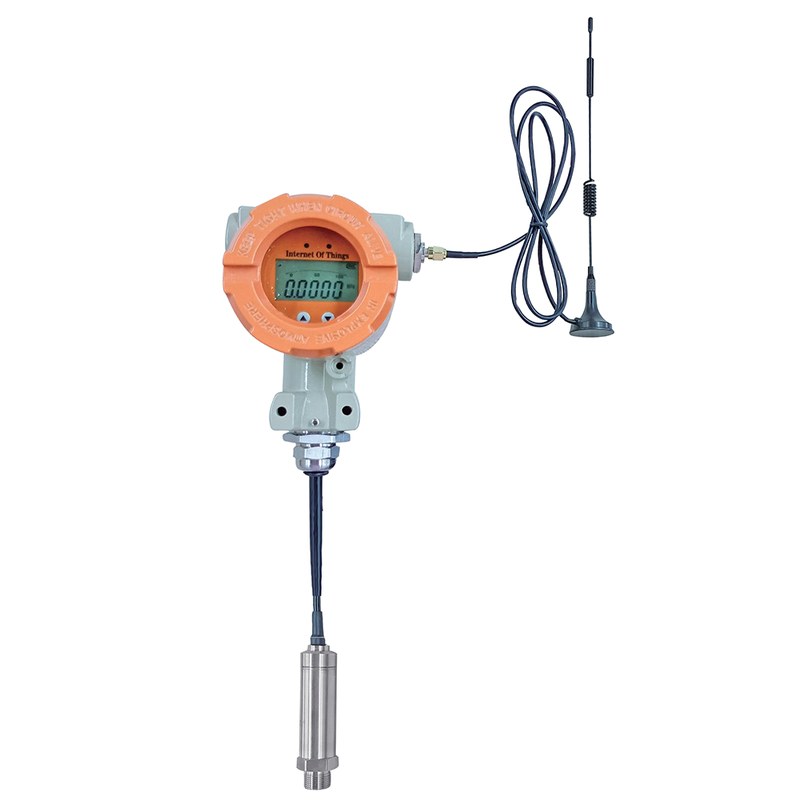
Ask any supplier for the energy budget behind a battery-life claim: the assumed reporting interval, the assumed signal strength, and the operating temperature. A "5-year battery" at 15-minute reporting and full signal can become "18 months" at 1-minute reporting from a poor-signal location. The same discipline applies to wireless level transmitters, which follow identical power budgets with pressure sensing at the bottom of a tank or well.
Key specifications to check when selecting a wireless pressure transmitter
Beyond the radio choice, six specifications decide whether the device survives your application:
| Parameter | What to ask | Why it matters |
|---|---|---|
| Pressure range and type | Gauge, absolute, or sealed; minimum and maximum span | Matching the range to the process determines accuracy and prevents overpressure damage |
| Accuracy | %FS, including temperature effects over your ambient range | Remote sites see the full outdoor temperature envelope |
| Wetted materials | 316L standard; check media compatibility (water, gas, chemicals) | A corroded diaphragm fails silently between reports |
| Ingress protection | IP67/IP68 for outdoor, buried, or submersible duty | Enclosures sit in weather, pits, and flooding zones for years |
| Hazardous-area rating | Ex d / Ex ia classification where required | Wireless does not remove the explosion risk — check the rating matches your zone |
| Operating temperature | Battery and electronics range, not just the sensor | Cold climates punish batteries; hot enclosures shorten life |
Two field realities worth stating plainly: a wireless transmitter is only as trustworthy as its pressure core — the sensing element, diaphragm, and seal are the same components as in a wired instrument, and they fail the same ways — and its enclosure, because it will sit outdoors unattended for years.
Industrial IoT applications of wireless pressure sensors
Wireless pressure monitoring earns its keep in applications where points are many, distances are large, or access is difficult:
Water distribution networks (smart water) — monitoring pressure at DMA boundaries, pump stations, and fire hydrants to detect leaks, bursts, and pressure anomalies across the city grid.
Oil, gas, and wellhead monitoring — remote wellhead and flow-line pressures without running kilometers of cable across lease roads.
Tank farms and storage — hydrostatic level and pressure monitoring of tanks, including submersible level transmitters for open tanks and wells.
Pump stations and pipelines — suction/discharge pressure and line pressure at unmanned stations.
Industrial IoT and predictive maintenance — trend pressure on compressors, hydraulic systems, and filters to schedule service before failure.
Hydrant and fire-suppression networks — verifying standby pressure in buildings and districts.
Environmental and groundwater monitoring — remote, solar-or-battery powered pressure/level logging.
The pattern across all of them is the same: the data is slow-moving but the point is expensive to visit.
Common deployment mistakes and how to avoid them
Assuming coverage where there is none. Verify carrier signal (NB-IoT/LTE-M/4G) or gateway range (LoRaWAN) at the actual installation point before committing — a steel tank or concrete pit changes the answer.
Setting the reporting interval for "nice-to-have" freshness. Every extra transmission shortens battery life and raises data cost. Specify the interval the application truly needs, and keep an alarm path for events.
Ignoring the antenna. Enclosures are often metal; antennas need clearance and correct orientation. A device bolted inside a steel cabinet may never transmit.
Skipping alarm strategy. A pressure spike between scheduled reports is invisible unless the device supports event-based or threshold-triggered transmission — require it for burst/leak detection duty.
No battery lifecycle plan. Even a 5-year battery eventually fails. Choose devices with replaceable batteries or a documented return/replacement path, and monitor battery voltage in the data stream so you replace on schedule, not in the field at 2 a.m.
Data flow: from sensor to SCADA or cloud
A wireless pressure monitoring system is a data pipeline, not a single product:
Field layer — battery-powered wireless pressure transmitters at each measuring point.
Network layer — either a carrier cellular network (NB-IoT/LTE-M/4G) or your own LoRaWAN gateways, which aggregate end-node packets over Ethernet/4G backhaul to the internet.
Platform layer — a network server and cloud platform that decodes packets, stores time-series data, and applies alarms.
Consumption layer — SCADA, dashboards, or your own application, typically pulling data through standard interfaces (MQTT, REST APIs, Modbus) rather than proprietary protocols.
When evaluating a supplier, ask what open interfaces the device and platform expose. Devices that only speak to the vendor's own cloud lock you in; devices that deliver data through standard protocols (MQTT, JSON payloads) integrate with the SCADA or IoT platform you already run.
How to choose a wireless pressure transmitter manufacturer
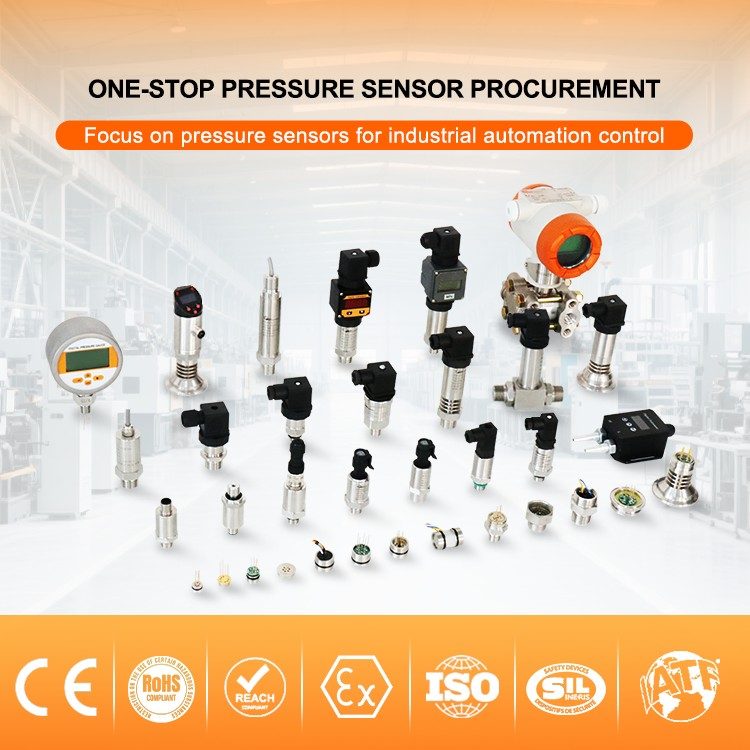
Five questions separate a serious instrument maker from a module assembler:
Do they make the pressure core, not just the radio? A manufacturer with in-house pressure sensor design and production controls accuracy, long-term stability, and quality in a way that radio-module integrators cannot. Ask which sensing element is inside.
Can they supply more than one radio option? A single instrument family spanning 4G, NB-IoT, and LoRaWAN lets you standardize hardware and match connectivity site by site.
Can they prove the battery-life claim? Ask for the energy budget: reporting interval, signal assumptions, temperature, and battery capacity behind the stated life.
Do they offer the full network picture? For LoRaWAN projects, a supplier that provides the gateway and end nodes (rather than only the sensor) makes system integration your choice, not their limitation.
What is the warranty? Instrument-grade warranty coverage — like WTsensor's 18-month warranty, longer than the industry-typical 12 — signals confidence in field reliability.
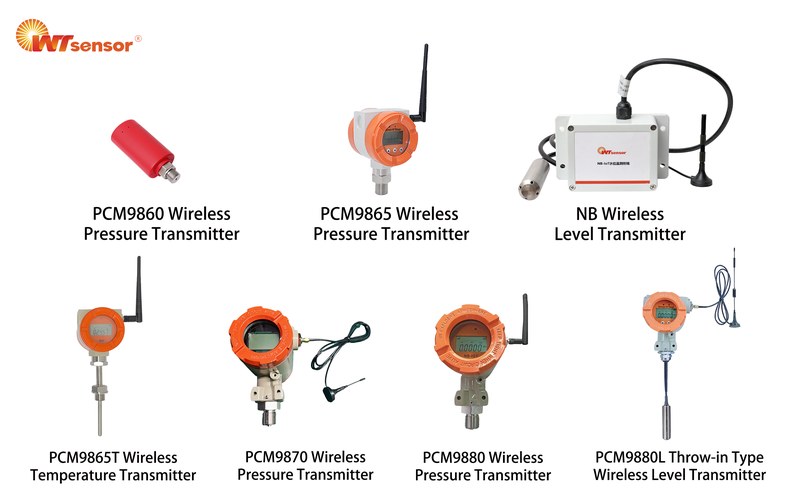
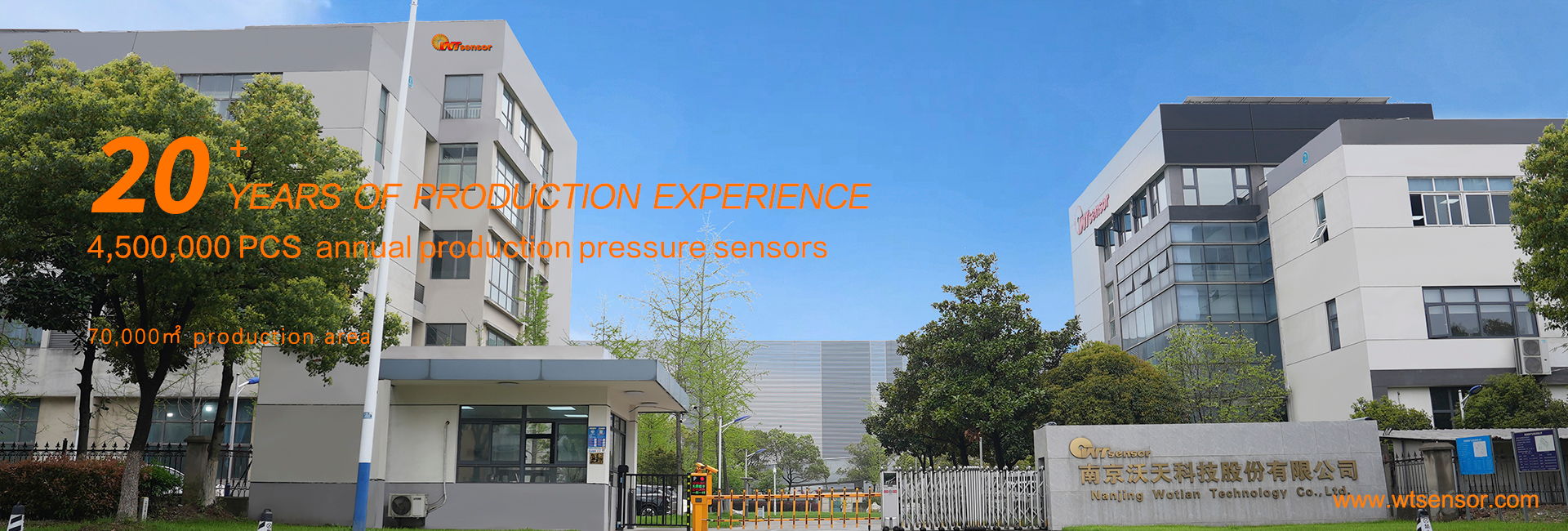
WTsensor (Nanjing Wotian Technology) is a pressure-sensor manufacturer founded in 2005, producing 4.5 million+ pressure sensors per year and exporting to 100+ countries from a 25,000 m² base with 70+ R&D engineers. Its wireless/IoT line includes the PCM9860 / PCM9865 / PCM9870 / PCM9880 family of wireless pressure and level transmitters in 4G, NB-IoT, and LoRaWAN versions, complemented by the G42/3 series LoRaWAN gateways for self-owned networks — with full in-house pressure sensing, all-316L wetted parts, and an 18-month warranty on every instrument. Detailed specifications (ranges, accuracy, battery life) are configuration-dependent and confirmed against the latest datasheet at quotation.
FAQ
What is a wireless pressure sensor?
A battery-powered pressure transmitter that measures pressure and sends readings wirelessly over a cellular network (4G, NB-IoT, LTE-M) or a private low-power network (LoRaWAN), eliminating the need for signal and power cabling at the measuring point. The term is often used broadly in search to include both the sensing element and the complete instrument.
How does a wireless pressure sensor send data to the cloud?
Through a four-stage data path: the transmitter samples pressure and sends a radio packet over its network — 4G/NB-IoT/LTE-M to a cellular base station, or LoRaWAN to a gateway you operate. The packet travels over the internet to a network server, which decodes it and forwards it to a cloud platform or your SCADA system. From there the data reaches dashboards, alarms, and historians.
Can wireless transmitters integrate with our existing SCADA or IoT platform?
Yes, if the device exposes standard interfaces such as MQTT, REST APIs, or Modbus, and if the data can be delivered to your own platform rather than only to the vendor's cloud. Open interfaces are the difference between integration and lock-in — ask the supplier which interfaces the transmitter and its network server support before you buy.
How long does the battery last in a wireless pressure transmitter?
Battery life is an energy budget driven mainly by the reporting interval, radio technology, and signal strength. Devices using high-capacity lithium-thionyl chloride cells are typically designed for multi-year life at hourly or daily reporting; always ask the supplier for the assumed interval and conditions behind any stated life.
What is the difference between NB-IoT, LTE-M, and LoRaWAN?
NB-IoT and LTE-M run on licensed cellular spectrum with carrier coverage and SIM-based connectivity; LoRaWAN runs on unlicensed spectrum over gateways you own. NB-IoT favors small, infrequent packets with deep coverage; LTE-M adds mobility and lower latency; LoRaWAN offers network ownership and very low power at limited payloads.
Can a wireless pressure transmitter be used in hazardous areas?
Yes, if the instrument carries the appropriate hazardous-area rating (for example Ex d or Ex ia) for the zone. Wireless transmission does not remove explosion risk — verify the rating against your area classification.
How often can a wireless pressure transmitter report?
Typical reporting intervals range from seconds to days depending on the radio and power budget. Frequent reporting shortens battery life; many devices also support event-based transmission, sending immediately when pressure crosses a threshold.
Is wireless pressure monitoring accurate enough for process use?
The measurement accuracy comes from the pressure core, not the radio — the same sensing-element technology as wired transmitters. Accuracy depends on the sensor element, range matching, and temperature compensation, so specify accuracy exactly as you would for a wired instrument.
What is the minimum order quantity for wireless pressure transmitters?
MOQ depends on the model, radio configuration, and options, and is confirmed during quotation. Contact us with your application details (site type, number of points, reporting interval) and we will include the MOQ and recommended radio choice in your quote.
Need help selecting a radio technology or sizing a deployment? Send us your application details — WTsensor responds with a technical evaluation and pricing within one business day.
-
Key Production Processes for Seal Pressure Transmitters
Read More > -
4 Quality Control Processes for Diffused Silicon Level Transmitters
Read More > -
Inside RTD Temperature Sensor Manufacturing Process
Read More > - Read More >
-
Inside Differential Pressure Sensor Core Manufacturing: From Gold Wire Bonding to Final Protection
Read More > -
What is a Glass-to-Metal Seal? Complete Guide for Engineers
Read More >