 Pусский

How to Choose a Wireless Pressure Transmitter: PCM9860, PCM9865 and the PCM9880 Family
From: Issued date 2026.10.22 Back
Once the decision to go wireless has been made, the question stops being "cellular or gateway?" and becomes a comparison between models. The datasheets differ in ways that are easy to miss: one model carries 19 Ah of battery and another 38 Ah, one is intended for indoor mounting only, only some offer a solar option, and on two of them the IP68 rating applies to the sensing section rather than to the instrument as a whole.
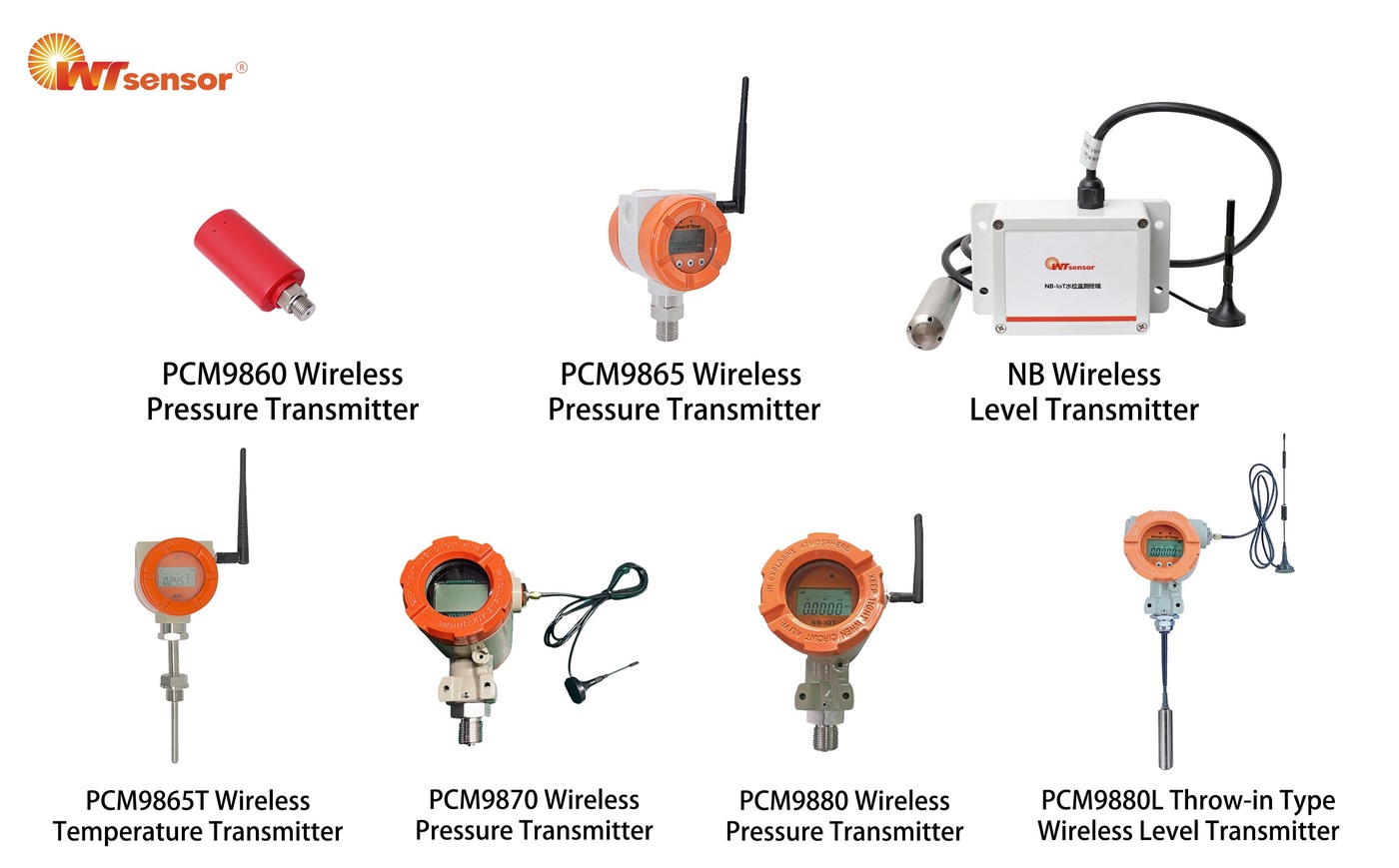
This guide compares the family model by model — PCM9860, PCM9865, PCM9880, PCM9880L and PCM9880W, with the G42/3 gateway where a private LoRaWAN network is used — and works through the eight decisions that separate them. Every figure quoted below is taken from the published datasheet for the model named.
Scope note: this page covers model-level selection inside the WTsensor wireless range. If wireless itself is still an open question, or you need the radio technologies compared in principle, start with What is a Wireless Pressure Sensor? Complete Guide for Industrial IoT, which covers the concept, the connectivity comparison and the battery-life arithmetic. The decisions below assume that choice is already made.
The eight decisions, in order
The network standard, and what it removes from the site
Whether the site needs its own gateway
Where the instrument physically sits: indoors, outdoors, or immersed
Battery capacity against reporting cycle
Whether the site operates below zero
Whether solar is part of the power plan
What accuracy you are actually buying once temperature is counted
Which pressure reference, and what "level" assumes
Decision 1: The network standard, and what it removes from the site
Our wireless line offers three network options across the family: NB-IoT, 4G, and LoRaWAN. The first question is not which is technically superior. It is which one leaves you with less equipment to install, power and maintain.
NB-IoT and 4G are cellular. The instrument registers with a mobile operator network, so there is no gateway to install, power, or maintain on site. The trade-off is that each device needs a subscription and must be within operator coverage.
LoRaWAN is a private radio network. Nothing leaves the site until it reaches a gateway, so you own the whole link. In exchange you must install and power that gateway, and your radio planning has to work.
Network support across the family:
| Model | Wireless networks supported |
|---|---|
| PCM9860 | NB-IoT / LoRaWAN |
| PCM9865 | NB-IoT / 4G / LoRaWAN |
| PCM9880 | NB-IoT / 4G / LoRaWAN |
| PCM9880L | NB-IoT / 4G / LoRaWAN |
| PCM9880W | NB-IoT / 4G / LoRaWAN |
The PCM9860 is the indoor model of the family and covers NB-IoT and LoRaWAN rather than 4G. The other four models carry all three networks. Whichever network you choose, state it explicitly at quotation, because it determines the radio fitted and, for LoRaWAN, whether a gateway enters the project.
Decision 2: Whether the site needs its own gateway
If you choose LoRaWAN, you need a gateway. If you choose NB-IoT or 4G, you do not. That is the whole of the decision, and it usually settles itself once Decision 1 is made.
Where a gateway is needed, the G42/3 Series indoor LoRaWAN gateway is the unit that pairs with our sensors. The published figures that matter at specification stage:
| Parameter | G42/3 Series |
|---|---|
| Protocol | LoRaWAN 1.0.2 / 1.0.3, Class A and Class C |
| Channels | 8 receiving channels, 1 downlink channel |
| Transmit power | Up to 27 dBm |
| Receiver sensitivity | -140 dBm @ SF12, BW125 kHz |
| Radio range | 12 km line-of-sight; 5 km in urban environment |
| Backhaul | Ethernet 10/100M and 4G, with data resumption after network disconnection |
| Server | Embedded LoRaWAN network server and application server |
| Data output | 4G, Ethernet and RS485, passive and active |
| Power | DC 9–28 V |
Two points on that table are worth dwelling on, because they change how projects get costed.
First, the gateway carries an embedded network server and application server. A separate LoRaWAN server is not required to get usable data out. That removes a piece of infrastructure that buyers often budget for out of habit, and it also removes a failure point.
Second, the 12 km and 5 km figures are radio range, not installation range. They describe the link under the stated conditions. Once the gateway sits inside a plant room and the sensors sit behind tanks, walls, and metal pipework, the usable distance is shorter than the headline number. Plan coverage by walking the site with the gateway in position, rather than by measuring the longest sight line on a drawing.
Decision 3: Where the instrument physically sits
Misreading a datasheet here is expensive, because the protection figures in our datasheets describe two separate parts of the instrument, not one.
| Model | Enclosure protection | Sensing section protection | Typical position |
|---|---|---|---|
| PCM9860 | Not stated; engineering plastics housing | Pressure port 316L | Indoor only |
| PCM9865 | Gauge head IP66/67 | Internal sensor 316L | Indoor or outdoor |
| PCM9880 | Gauge head IP66/67 | Internal sensor 316L | Indoor or outdoor |
| PCM9880L | Gauge head IP66/67 | Throw-in sensor part IP68 | Head above liquid, sensor immersed |
| PCM9880W | Gauge head IP66/67 | Submersible sensor part IP68 | Head above liquid, sensor immersed |
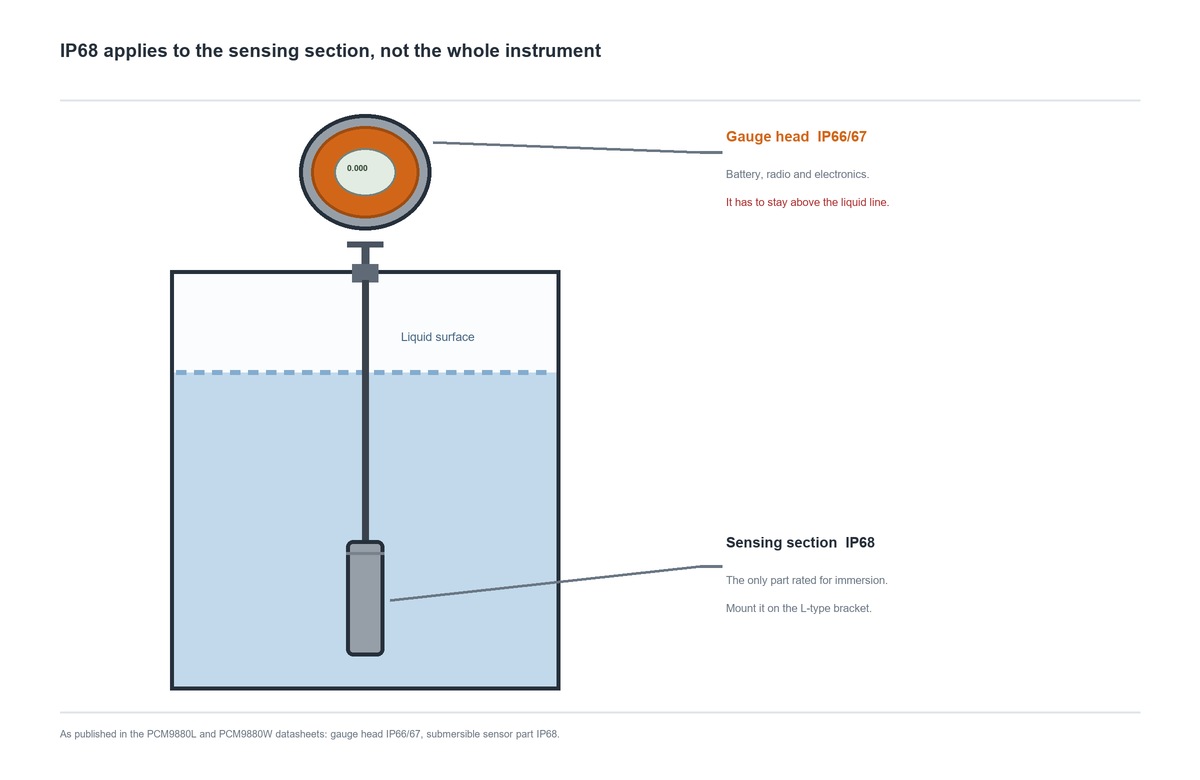
The IP68 figures on the PCM9880L and PCM9880W belong to the sensing section. The gauge head, where the battery, radio, and electronics sit, is IP66/67. On both models the head stays out of the liquid and only the sensing part is immersed, which is why both datasheets describe the mounting as an L-type bracket.
That distinction matters when a buyer reads "IP68" and concludes the instrument can simply be dropped into a wet sump. It cannot: the head has to remain above the liquid line. If your installation point floods to a level above the head mounting, the correct answer is to raise the bracket, not to assume the rating covers it.
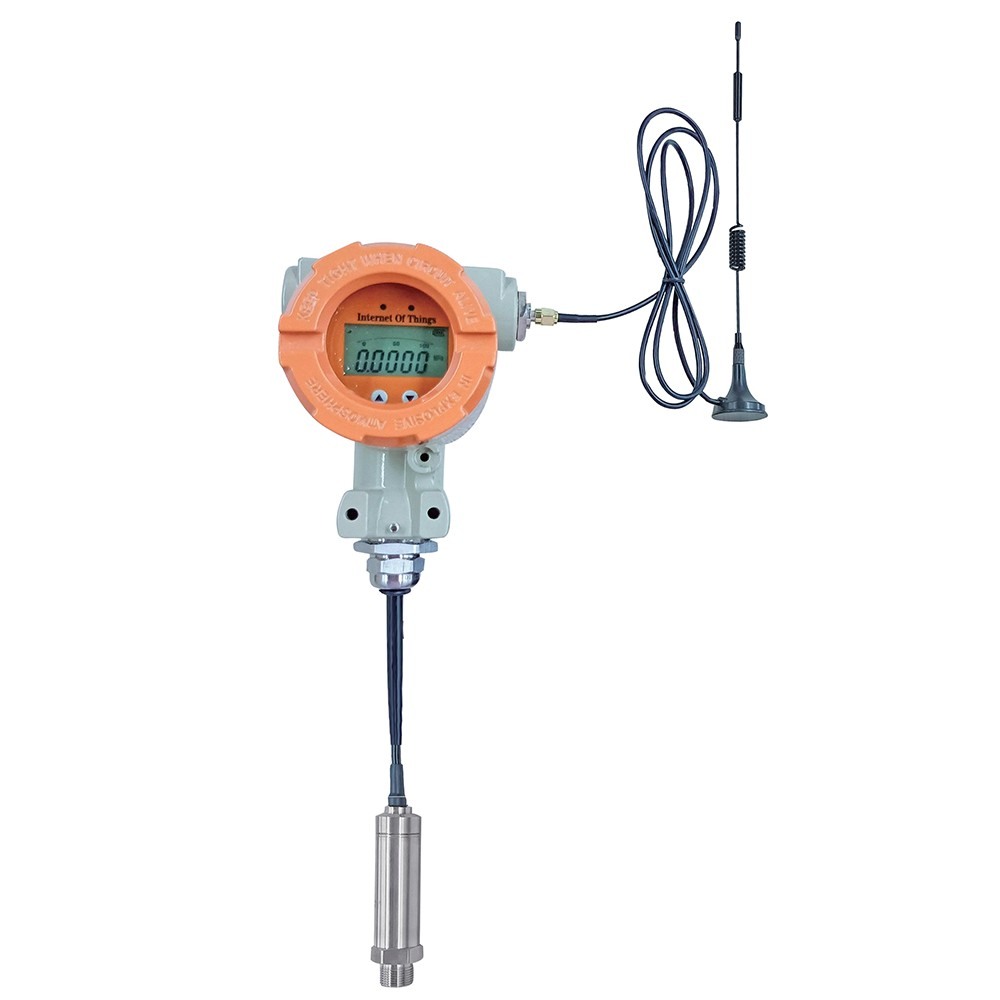
For the PCM9860 the position is narrower still. Its datasheet describes it as an indoor transmitter developed for intelligent fire protection sites, and describes it as suitable for an indoor environment, with an engineering plastics housing and no ingress protection grade stated. It is a good fit for a plant room or a riser cupboard. It is not the model for an exposed pipe bridge.
Decision 4: Battery capacity against reporting cycle
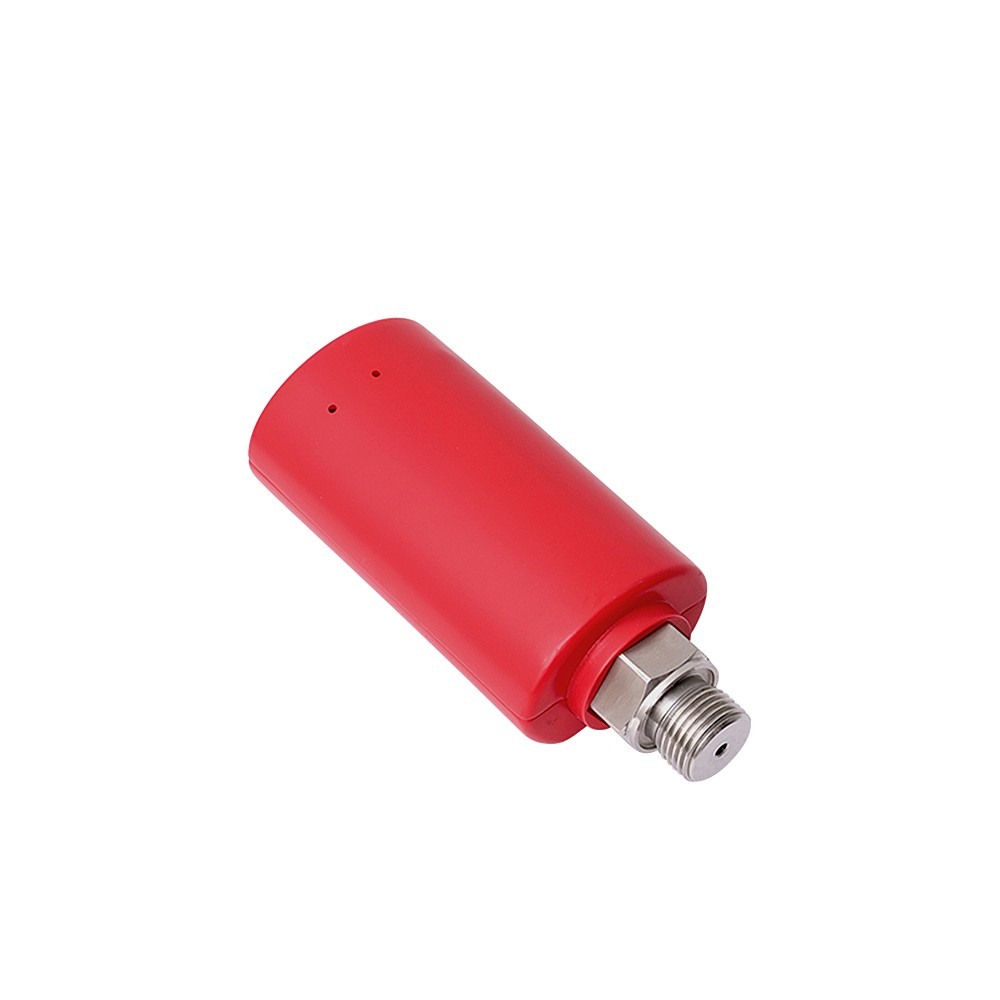
Two battery sizes run through the family. The PCM9860 and PCM9865 carry a 19 Ah lithium sub-battery. The PCM9880, PCM9880L and PCM9880W carry 38 Ah.
Every datasheet in the family states the same thing about the reporting cycle: regular active report, with the cycle settable at will, remotely. So the cycle is not a factory setting you are stuck with; it is a commissioning decision that you can revisit.
That is also why we do not publish a single battery-life figure. Life is the product of capacity, transmit power, cycle, and ambient temperature, and quoting one number would describe a configuration rather than a product. If you tell us the cycle you intend to run, we will give you the corresponding estimate for the model you have chosen. A buyer who is comparing suppliers should treat a flat "five years" claim with suspicion unless the cycle and the temperature are stated alongside it.
What can be said from the datasheets without qualification: doubling the reporting frequency shortens life, moving from 19 Ah to 38 Ah lengthens it, and running the radio in a colder environment works against you. The last point has its own decision.
Decision 5: Whether the site operates below zero
All five datasheets in the family carry the same note in the operating temperature row. The wording differs slightly between documents but the content does not: sub-zero temperature has a significant effect on the performance of the lithium sub-battery.
| Parameter | Value across the family |
|---|---|
| Operating temperature | -20 °C to 70 °C |
| Medium temperature | -20 °C to 85 °C |
| Storage temperature | -40 °C to 125 °C (PCM9865 datasheet notes: except the batteries) |
| Battery behaviour below zero | Significant effect on performance, stated in every datasheet in the family |
Two things follow, and they are easy to conflate.
First, the medium can be hotter than the electronics can comfortably sit in. The medium range reaches 85 °C while the operating range stops at 70 °C. A hot fluid running through a cool plant room is not a problem; a hot fluid in a hot plant room is, because the head takes the ambient, not the fluid temperature.
Second, a winter site is a battery site. The datasheets state the effect but do not quantify it across the temperature band. On an outdoor installation in a climate that spends weeks below freezing, the honest approach is to size the cycle conservatively and to ask us for the expected behaviour at your minimum ambient rather than to assume the headline capacity holds.
Solar is published as an alternative supply, not as a charging arrangement. Our datasheets list solar energy alongside the battery and describe no energy management behind it, so how it interacts with the battery, and how it behaves under your site’s actual sunlight hours, are questions for the factory rather than something to infer from the supply line.
Decision 6: Whether solar is part of the power plan
Solar is supported on four of the five models and absent from one. This is the kind of detail that only surfaces when the specification is checked line by line.
| Model | Power supply as published |
|---|---|
| PCM9860 | Lithium sub-battery (19 Ah) or solar energy |
| PCM9865 | Lithium sub-battery (19 Ah) |
| PCM9880 | Lithium sub-battery (38 Ah) or solar energy |
| PCM9880L | Lithium sub-battery (38 Ah) or solar energy |
| PCM9880W | Lithium sub-battery (38 Ah) or solar energy |
If a solar-assisted installation is a requirement, the PCM9865 is out of scope on its own datasheet, and the choice narrows to the PCM9880 family or the PCM9860. If a 19 Ah battery on a non-solar model is otherwise the right fit, that is a reason to set the reporting cycle more conservatively rather than to change model.
Decision 7: What accuracy you are actually buying once temperature is counted
The headline accuracy across the family is 0.5 %FS. Every datasheet also publishes a temperature term, and in this family the temperature term is larger than the headline figure.
| Parameter | Value across the family |
|---|---|
| Overall accuracy | 0.5 %FS |
| Zero temperature error | ±1.5 %FS (-20 °C to 85 °C) |
| Span temperature error | ±1.5 %FS (-20 °C to 85 °C) |
| Long-term stability | ±0.2 %FS per year |
| Sampling resolution | 24 bit |
A buyer comparing two datasheets will often stop at the 0.5 %FS line and treat the two products as equivalent. The temperature term is what separates them in service, and here it is stated over a band wider than the operating range itself: ±1.5 %FS across -20 °C to 85 °C.
What the datasheet does not do is break that figure down per degree. So the correct reading is not "this instrument drifts 1.5 %FS in my plant". It is: over the full published band the temperature contribution reaches that magnitude, and within a narrower band it contributes less, by an amount we can only quantify from the characterisation data for the specific model. If your ambient swing is wide, ask for that data rather than interpolating the band figure yourself.
Two cautions on reading those two entries. Zero and span are published separately and the datasheets state no combined figure, so the two should not be added arithmetically to produce a worst case. And the band the temperature terms are quoted over, -20 °C to 85 °C, is not the same band as the operating range, which stops at 70 °C; the wider figure is a characterisation band rather than an operating claim.
For context on scale: an outdoor installation that swings from -5 °C in winter to 40 °C in summer spans a quarter of the published band. That is a meaningful part of the error budget on a 0.5 %FS instrument, and it is invisible if you only read the headline accuracy.
Decision 8: Which pressure reference, and what "level" assumes
Three references appear throughout the family: gauge (G), absolute (A) and sealed gauge (S). The range table decides more of this than buyers expect, because the three reference families cover different spans.
| Reference | Range codes published in the family | Span covered |
|---|---|---|
| Gauge (G) | 10kG, 20kG, 35kG, 70kG, 100kG, 160kG, 250kG, 400kG, 600kG, 1MG | 0–10 kPa up to 0–1 MPa |
| Absolute (A) | 35kA, 100kA, 160kA, 250kA, 400kA, 600kA | 0–35 kPa up to 0–600 kPa |
| Sealed gauge (S) | 1.6MS, 2.5MS, 6MS, 10MS, 16MS, 25MS, 40MS, 60MS | 0–1.6 MPa up to 0–60 MPa |
Read down the third column and a practical constraint appears. The gauge codes end at 1MG, which is 0–1 MPa. Beyond that code the published table continues with sealed gauge, starting at 1.6MS. So a buyer who needs 1.6 MPa and would naturally ask for gauge pressure is, in this family, specifying 1.6MS. That is not a downgrade: sealed gauge references the sensor to a sealed reference instead of to atmosphere, so the zero does not move with the weather.
The reference itself is decided by what the process is referenced to, not by the span. Where the process is open to atmosphere — a vented tank, a drain line, any point that breathes — gauge is the correct reference, and it stays correct at any span, because atmospheric pressure acts on the process and on the reference side together, so the two cancel instead of accumulating. A sealed-gauge instrument on the same point would read the barometric swing as signal. The reverse holds for a closed or pressurised process: there the reading has to exclude atmosphere, and a gauge reference would add it in. A small span makes that addition a larger fraction of the reading, which is why the span and the reference are usually asked about in the same breath — but the reference question is settled first.
One further point applies only to the PCM9880L. Its datasheet states the liquid level type as medium level at atmospheric pressure. That is an open-vessel assumption. On a closed or pressurised tank, the headspace pressure adds to the column pressure at the sensor, and the instrument will read that sum. If your vessel is sealed, the level transmitter is the wrong instrument for the job and a differential measurement is the right one.
One span is worth checking per model rather than across the family. The PCM9865 performance table states 25 MPa as its top span, while the range-code table in the same datasheet carries 40MS and 60MS. The code table governs what can be ordered; where the required span sits beyond the performance-table figure, confirm it at quotation.
The family at a glance
| Model | Network | Battery | Range | Protection | Position |
|---|---|---|---|---|---|
| PCM9860 | NB-IoT / LoRaWAN | 19 Ah, solar optional | 0–10 kPa to 0–60 MPa | Not stated; engineering plastics | Indoor |
| PCM9865 | NB-IoT / 4G / LoRaWAN | 19 Ah, no solar | 0–35 kPa to 0–25 MPa | Gauge head IP66/67 | Indoor or outdoor |
| PCM9880 | NB-IoT / 4G / LoRaWAN | 38 Ah, solar optional | 0–10 kPa to 0–60 MPa | Gauge head IP66/67 | Indoor or outdoor |
| PCM9880L | NB-IoT / 4G / LoRaWAN | 38 Ah, solar optional | 0–0.5 m to 15 m H2O | Head IP66/67, sensor IP68 | Throw-in level |
| PCM9880W | NB-IoT / 4G / LoRaWAN | 38 Ah, solar optional | 0–10 kPa to 0–60 MPa | Head IP66/67, sensor IP68 | Submersible pressure |
One note on the Range column: the figures are the spans stated in each model’s performance table, and they are not continuous spans. A range is chosen from a published code table, and the codes are listed under Decision 8.
A worked specification
The sequence is easier to see with a real case. A buyer is monitoring a fire main in an outdoor pump house. Working pressure is 1.6 MPa. There is no mains power at the tapping point and no cabling route back to the panel. The site already uses 4G for other equipment. Ambient runs from -5 °C in winter to 45 °C in summer. They want a reading every 30 minutes.
Network. The site already has 4G coverage and no gateway infrastructure. Choosing 4G removes the gateway from the project entirely. LoRaWAN would add a unit to power and maintain for no gain here.
Position. Outdoor, so the enclosure has to be rated. The PCM9860 is described in its datasheet as an indoor transmitter with an engineering plastics housing and no stated ingress grade, so it leaves the shortlist.
Temperature. Winter reaches -5 °C, where every datasheet in the family warns about battery behaviour. That argues for 38 Ah over 19 Ah. If the site wants the solar option at all, that also points away from the PCM9865 and towards the PCM9880.
Range and reference. At 1.6 MPa the published range table offers sealed gauge: code 1.6MS. Gauge codes in this family stop at 1MG, or 0–1 MPa. A sealed reference also removes barometric variation from the reading.
Accuracy. A 50 K ambient swing sits inside a published temperature band of -20 °C to 85 °C. The buyer should know that the ±1.5 %FS temperature term reaches its stated magnitude across that wider band, and ask for characterisation data rather than assume the 0.5 %FS headline holds across the year.
Connection. C1, M20×1.5, matching the tapping already on the pipe.
The resulting order code is PCM9880-1.6MS-4G-C1. Every element of it is traceable to a published range table, power supply line, or connection table in the datasheet.
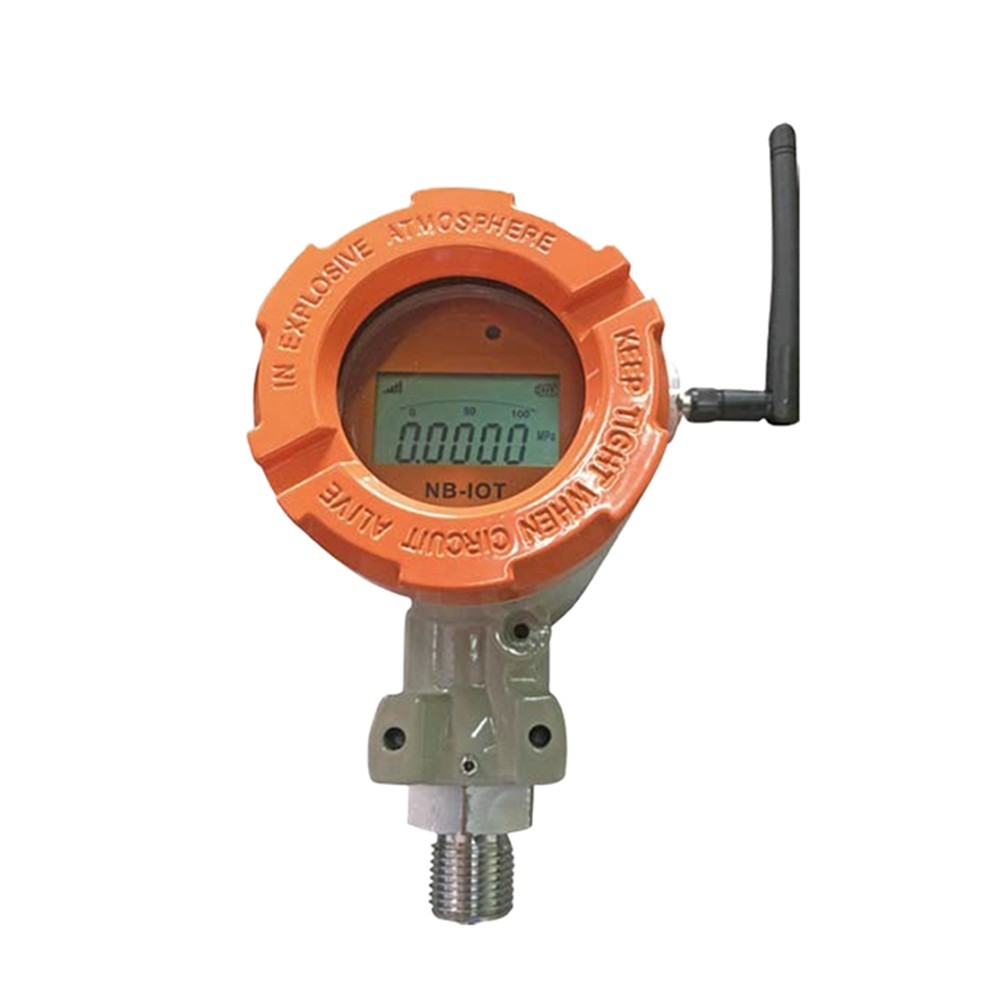
If the pump house were indoors and heated, the same requirement would land on the PCM9865 at 19 Ah, because the temperature argument that drove the choice of the 38 Ah model would no longer apply. That is the point of working through the decisions in order: the model number falls out of the constraints instead of being picked first and justified afterwards.
Common specification mistakes
These are errors that surface when a wireless requirement arrives as an email rather than as a specification.
Reading IP68 as covering the whole instrument. On the PCM9880L and PCM9880W the IP68 rating belongs to the sensing section. The gauge head is IP66/67 and stays above the liquid. An installation that floods above the head mounting is a mounting problem, not a rating problem.
Ordering a 19 Ah model for a cold, high-cycle site. The PCM9860 and PCM9865 carry 19 Ah; the PCM9880 family carries 38 Ah. Where a site runs cold and reports often, the smaller battery is the wrong place to save cost.
Assuming solar is available throughout the family. The PCM9865 datasheet lists a 19 Ah lithium sub-battery with no solar option. Four models in the family offer solar; this one does not.
Asking for gauge pressure beyond the range table. The published gauge codes stop at 1MG, or 0–1 MPa. From 1.6MS upward the table offers sealed gauge, which is a legitimate specification rather than a compromise — provided the process is one that should be referenced to a sealed reference rather than to atmosphere.
Comparing headline accuracy and ignoring the temperature term. Two instruments at 0.5 %FS can behave differently across a year if their temperature coefficients differ. In this family the zero and span temperature terms are each ±1.5 %FS across -20 °C to 85 °C.
Using a level transmitter on a closed tank. The PCM9880L is specified for medium level at atmospheric pressure. Headspace pressure in a sealed vessel adds to the reading.
Choosing a reporting cycle without checking it against winter. Cycle and low temperature act on the same battery. A cycle that is comfortable in summer is not automatically comfortable in February.
Ordering the cable by assumption. Both the PCM9880L and the PCM9880W ship with a 2 m PE cable as standard. Cable length is selectable in the order code, and each datasheet treats a longer run as a customisation item rather than a stock option. Confirm the length with the order.
What to send us for a quotation
A wireless enquiry that arrives with these eight items can be quoted without a round of questions:
The measurement: pressure in MPa or kPa, or level in metres of water
Working pressure and the maximum pressure the point can see
Whether the process is referenced to atmosphere, sealed, or absolute
Environment at the head: indoor, outdoor, or immersed, and the minimum and maximum ambient
Network preference, or the constraint that decides it: existing operator coverage, existing gateway, or neither
Required reporting interval and any alarm thresholds
Whether solar is required
Destination platform: Telecom AEP, Alibaba Cloud, or your own
If items 4 through 6 are still open, send them as open questions rather than as guesses. Those three are where the model choice is decided.
Where to go next
If the requirement is not yet settled, these guides cover the adjacent decisions:
For the concept itself, the radio comparison and the battery-life arithmetic, see what a wireless pressure sensor is.
For the wired equivalent of this decision set, see how to choose a pressure transmitter.
For contact-type level measurement by hydrostatic head, see how to select a submersible level transmitter.
For the sensing element inside the instrument, see how to select a pressure sensor core.
For an instrument already installed and reading unexpectedly, see pressure transmitter troubleshooting.
Related product pages:
PCM9865T wireless temperature transmitter — the temperature version of the PCM9865 above, on the same network options
NB wireless level transmitter — an NB-IoT level variant outside the model set above
About WTsensor
Nanjing Wotian Technology builds the wireless instruments described here around three network options, two battery capacities, and a shared measurement core, which is why the same selection logic applies across the family. Instruments are configured at order rather than assembled from a fixed catalogue: pressure reference, range, thread, cable length and cable material are all order-code fields, the network standard joins them on the models whose code carries a network field, and the network server can be Telecom AEP, Alibaba Cloud, or a customer platform. Where a LoRaWAN installation needs its own radio infrastructure, the G42/3 gateway carries the network server and application server inside the unit, so the site does not need a separate server to produce usable data.
For buyers specifying wireless monitoring for fire protection, municipal water, or pipeline applications, we will work through Decisions 1 to 8 against your site conditions and return a configuration with the source document for each parameter.
Frequently asked questions
Do I need a gateway? Only for LoRaWAN. NB-IoT and 4G instruments register directly with an operator network, so no gateway is installed on site.
How long will the battery last? We do not publish a single figure, because life depends on capacity, transmit power, reporting cycle and ambient temperature. Send us the cycle and the minimum ambient and we will return an estimate for the model you have chosen.
Will it work through winter? The operating range reaches -20 °C, and every datasheet in the family notes that sub-zero temperature significantly affects lithium sub-battery performance. On a site that spends weeks below freezing, size the cycle conservatively and ask for expected behaviour at your minimum ambient.
Is the instrument IP68? On the PCM9880L and PCM9880W the sensing section is IP68 and the gauge head is IP66/67. The head stays above the liquid.
Can the readings go to our own platform? Yes. The instruments are described as accessible to third-party monitoring platforms, with Telecom AEP, Alibaba Cloud and private platforms named in the datasheets.
Why is there no gauge-pressure code beyond 1MG? The published range table in this family covers gauge pressure up to 1MG, or 0–1 MPa. Beyond that span the table offers sealed gauge, which is referenced to a sealed reference instead of to atmosphere.
Can one gateway serve several instruments? Yes. The G42/3 Series provides 8 receiving channels and 1 downlink channel, and carries an embedded network server and application server, so multiple sensors can report through one unit.
-
What is a Metal Bellows? Complete Guide for Engineers
Read More > -
What is a Wireless Pressure Sensor? Complete Guide for Industrial IoT
Read More > -
How to Choose a Pressure Transmitter: A Complete Selection Guide
Read More > -
Hydrostatic Level Measurement: How to Select a Submersible Level Transmitter
Read More > -
How to Select a Pressure Sensor Core: A Complete Selection Guide
Read More > -
Why a Wrong Pressure Transmitter Reading Is Usually Not a Broken Transmitter
Read More >
This article Tags: wireless pressure transmitter PCM9860 PCM9865 PCM9880 PCM9880L PCM9880W NB-IoT LoRaWAN selection
Back to List